

Widening the Circle | Rewilding Update
Feun Foo Permaculture & Rewilding Update (December 2025) --- [Estimated reading time: 30 min.]

A lot has happened since I over-confidently (and, to my regret, publicly) mused about whether I could publish these Updates monthly – about a year ago now – and although there is no shortage of things to write about (and I still have a few of them backlogged for various reasons), it might be a better idea to inject a quick Update explaining my (renewed) sabbatical. As usual, I’m far behind on my writing schedule, so this piece describes events between August and December 2025. (I know, I know…)
The season of plenty… (plenty of work!)
Last year’s fruit season was – as always – the busiest time of the year, by a far margin. There were twelve-hour workdays processing Antidesma montanum into wine, countless boxes of mangosteen that had to be washed, boxed and shipped, and an incredible abundance of food of all sorts.
Staying busy is, contrary to popular opinion, in and of itself not a bad thing at all, provided that what you’re busy with is has a deeper meaning or purpose for you. And hence, while society around us plunged into the fiery hell of xenophobia, we retreated from the AI-slopped online spaces and got busy where it matters most: on the land that sustains us.
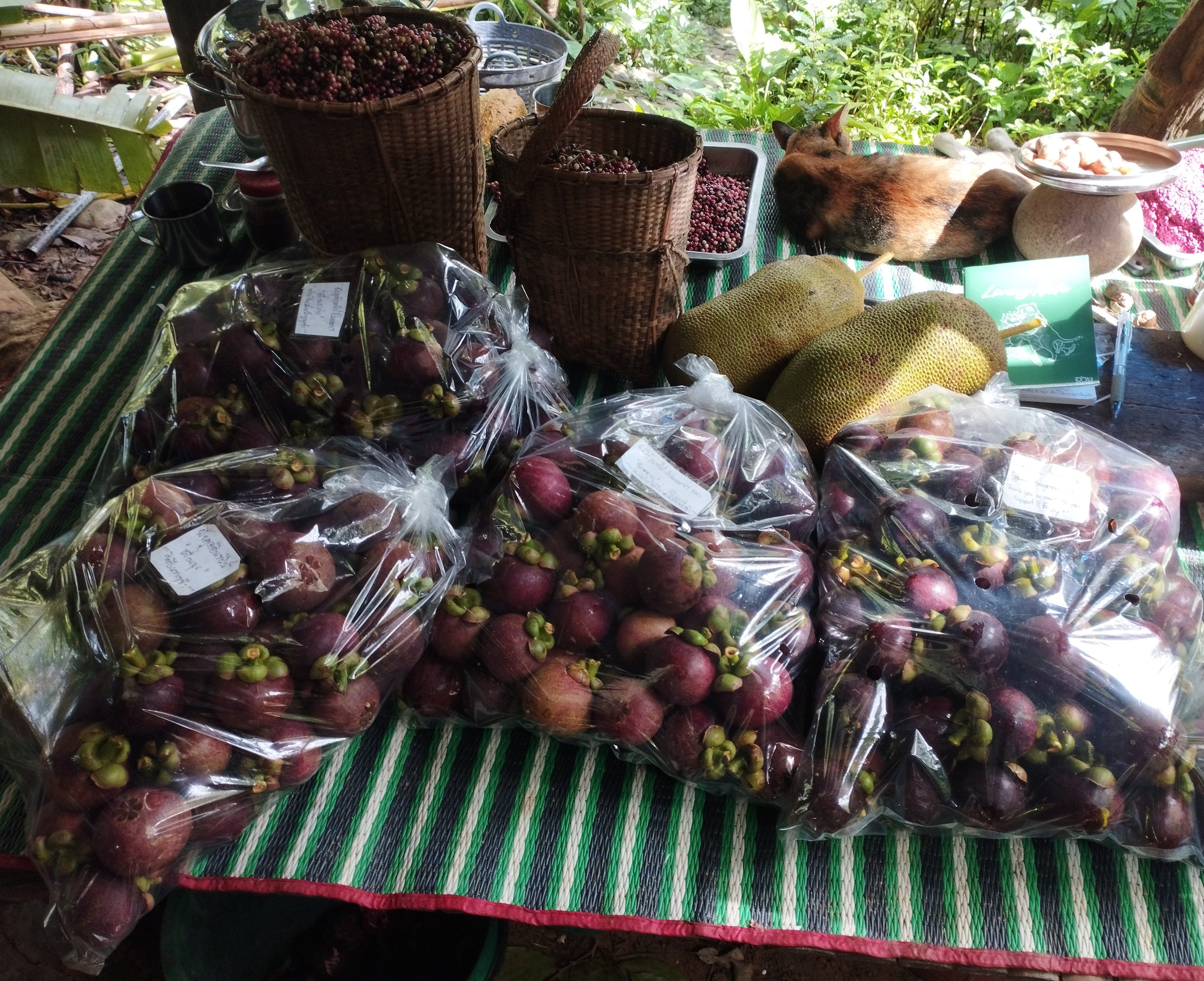
What follows after the main fruit season is usually a period of heavy rain lasting about two to three months, during which we get around to do all sorts of reading and writing that has accrued. Last year, this “creative break” was cancelled for the first time since we moved here, so we worked pretty much all year round. And while we usually hold our “free time” in high regard, the collapse of global civilization is ramping up – and we hadn’t even started the most important and most difficult part of our preparations: in the words of every other guest on The Great Simplification, “we need to build community.”
“Coh-myoo-niddy.”
Widening the Circle
As I’ve described in the previous Rewilding Update, we have long planned to engage a few more people in our local community in small, mutually beneficial projects aimed at raising ecological, societal and economic awareness, adapting to both an increasingly erratic climate and unstable economy, and creating local food systems resilience, aka. food sovereignty. I wouldn’t go as far as to call it a full-blown “community project” – we still value our arm’s-length distance to most of what’s happening in the village below – but we are ready for a few compromises on our hermit lifestyle, given they meet the following criteria:
There must be an obvious ecological benefit resulting from our work (i.e. “Earth Care”);
There must be a tangible benefit for everyone involved, preferably one that is about more than a financial transaction or future monetary profit (i.e. “People Care”);
We don’t want to come into direct contact with agricultural chemicals;
We try to avoid or minimize the use of artificial fertilizer1 (but don’t categorically dismiss it);
While doing all the aforementioned, we carefully select opportunities to (even more carefully) address systemic big-picture topics such as biodiversity collapse, climate change, resource scarcity, or any other aspect of the metacrisis, as well as the benefits of seed-saving and the various ecological approaches to food cultivation. (Some such attempts are paraphrased in guillemets in the following.)
Considering all the aforementioned factors, we are still a humble, two-person project, so everything we do takes a while (as we also have to take care of our own garden and all it’s various inhabitants, do chores, etc. so we couldn’t allocate too much time to each such project).
Unfortunately, all our Laotian friends (who worked as farm hands in the village) had to return home for a variety of reasons (treatment and pay being the foremost), so we found ourselves right back where we started in terms of social circle diameter. It appears that farm hands don’t stay in one place for long these days. The first few months of the season are usually fine, but as the harvest approaches the workload increases, gradually perks disappear and expectations mount. They get exploited, scolded and gossiped about until they have enough and leave (usually after the main workload of the season is done), try to find employment somewhere else – and the cycle begins anew.
For our community-building plans, this meant back to the drawing board.
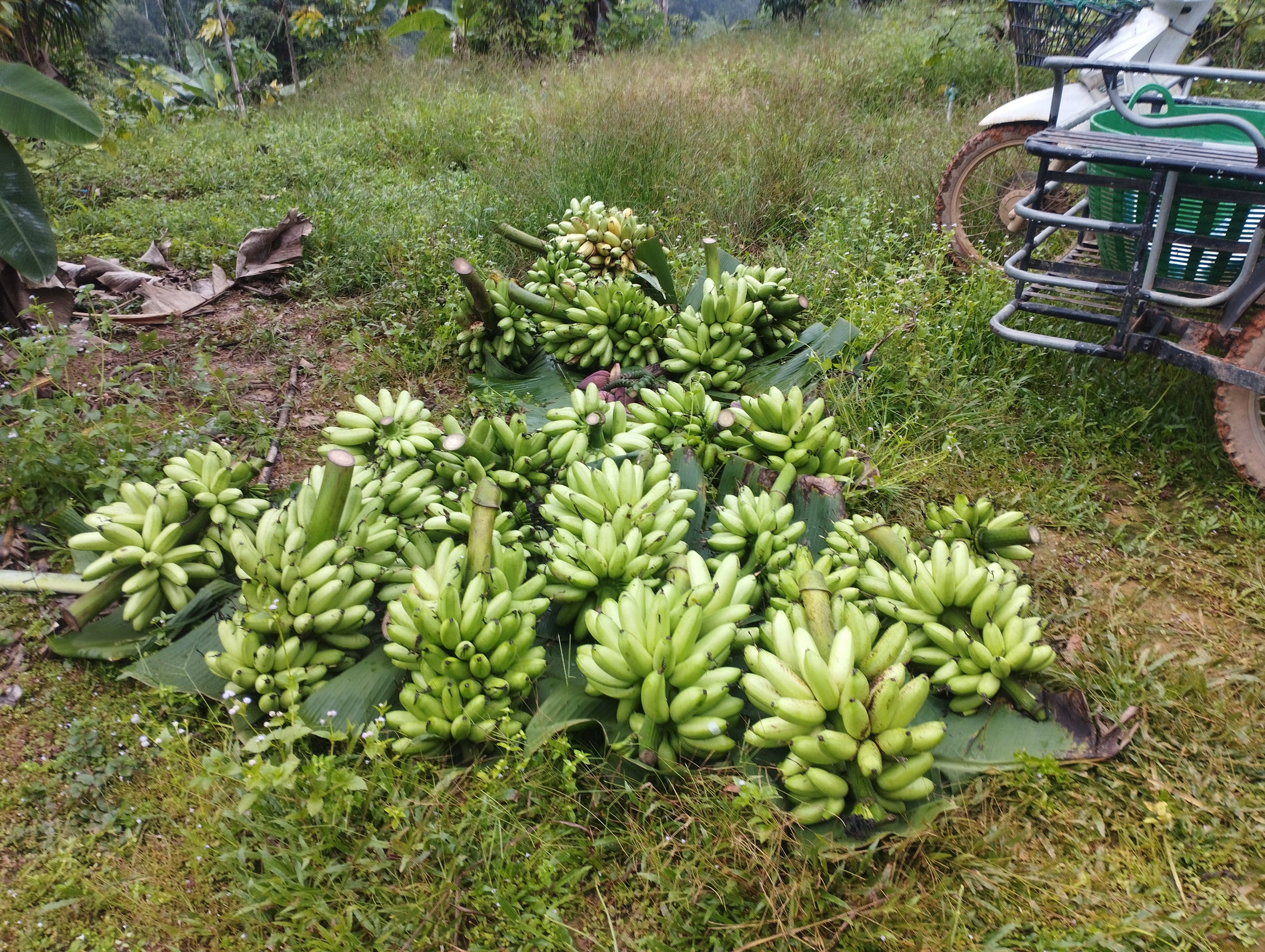
An older farmer with a lot of land invited us to prune and thin his banana plants, and in exchange we could keep the (meager) earnings from selling bananas (about four Baht per kilo) and all bunches that couldn’t be sold (as they approach maturity the fruit splits open easily in rainy season), which we ate and fed to the rabbits and chickens. But soon after, ignoring our pleas, he sprayed herbicide again, so we stopped visiting his plantation.
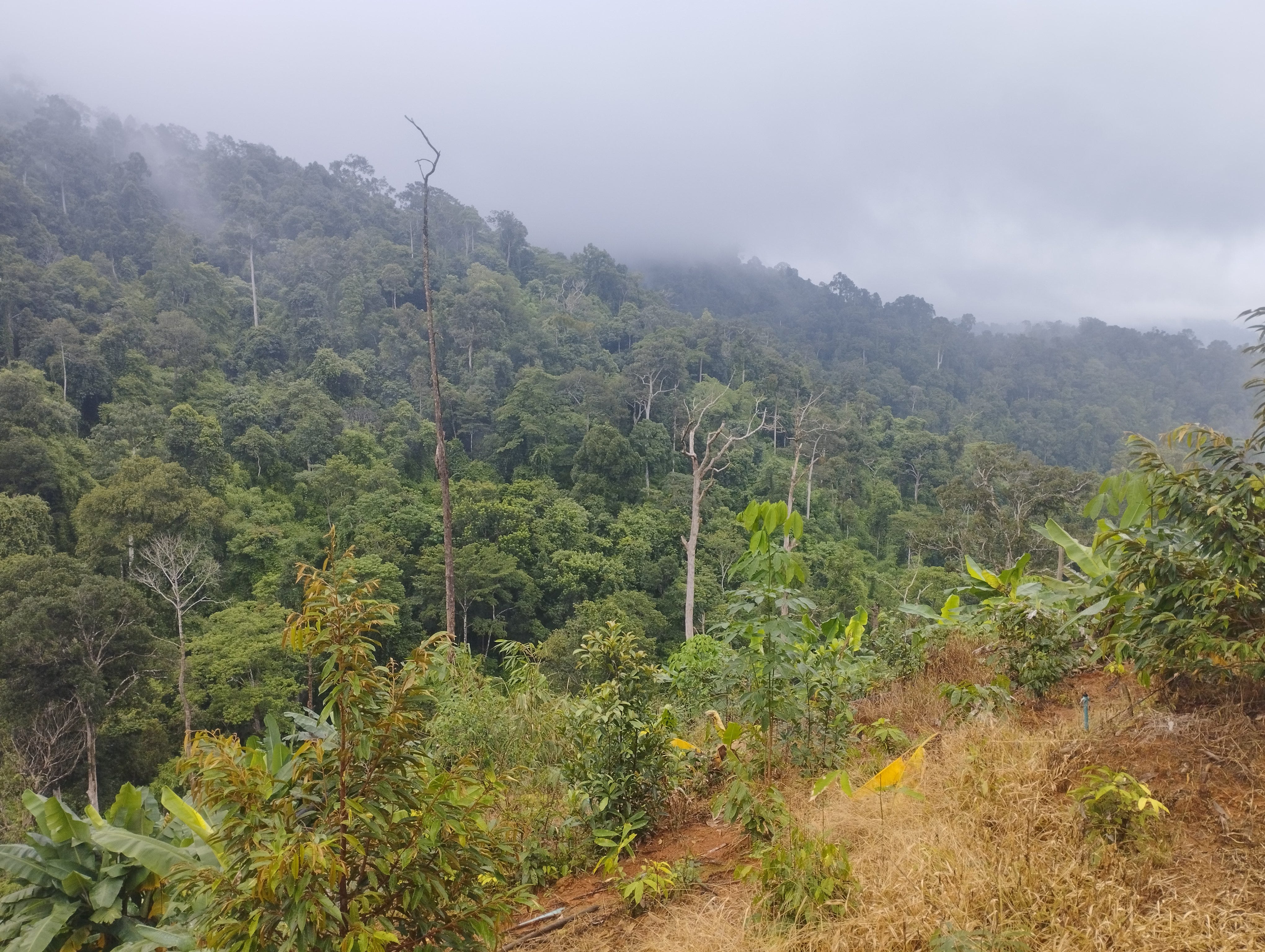
And, alas, as we continued to canvass those with the least extreme ecocidal aspirations, we were able to secure a collaboration with a local farmer and friend of ours:
The Hill Rice Experiment!
Yes, we decided it was time to try planting rice ourselves.
Initially, we planned to slash a small plot of our highest land and carefully burn it once it’s dry enough, but the sudden shift into full monsoon surprised us (again!) and thwarted our plans right after the slashing phase.
Instead of waiting for another year, Karn eagerly looked for other opportunities to realize this long-held dream of hers. Staple food production will have to become more localized eventually, so we are just the first ones around here to pick it up again.
Even more importantly, it was our first promising (and at least partly successful) attempt at reaching out to others in the village, slowly beginning the momentous task to build community resilience – and hopefully even changing some hearts & minds along the way.
What we are doing at Feun Foo Permaculture & Rewilding is a version of forest gardening, wildtending, and various indigenous horticultural techniques slightly modified to suit our unique local conditions; as such, it produces a wide variety of different non-grain staple foods like cassava, arto nuts, and (coco)yams. As such, it is far too “extreme” for anyone in this society to even theoretically consider as a viable alternative to paddy rice monocropping – (Southeast) Asians share a profound cultural bond to rice as their “daily bread” that they are not going to abandon voluntarily.
If we want to nudge people from monocropping to more diverse and ecologically sane forms of plant cultivation, we will first have to make a huge step into their direction. And so, in spite of James C. Scott’s excellent argument against grain as a main staple, we effectively became part-time rice farmers for a season.
Despite my decade-long aversion to (and successful evasion from) agri-culture – plant cultivation on the scale of a field – I suddenly found myself somewhere in the middle of the spectrum between forest forager and field farmer. Surprisingly enough, it has been a refreshing change.
It was clear that what we wanted to do was a lot more similar to the methods of the region’s last shifting cultivators, whom Karn was very lucky to visit last year to assist with the rice harvest in their swiddens.
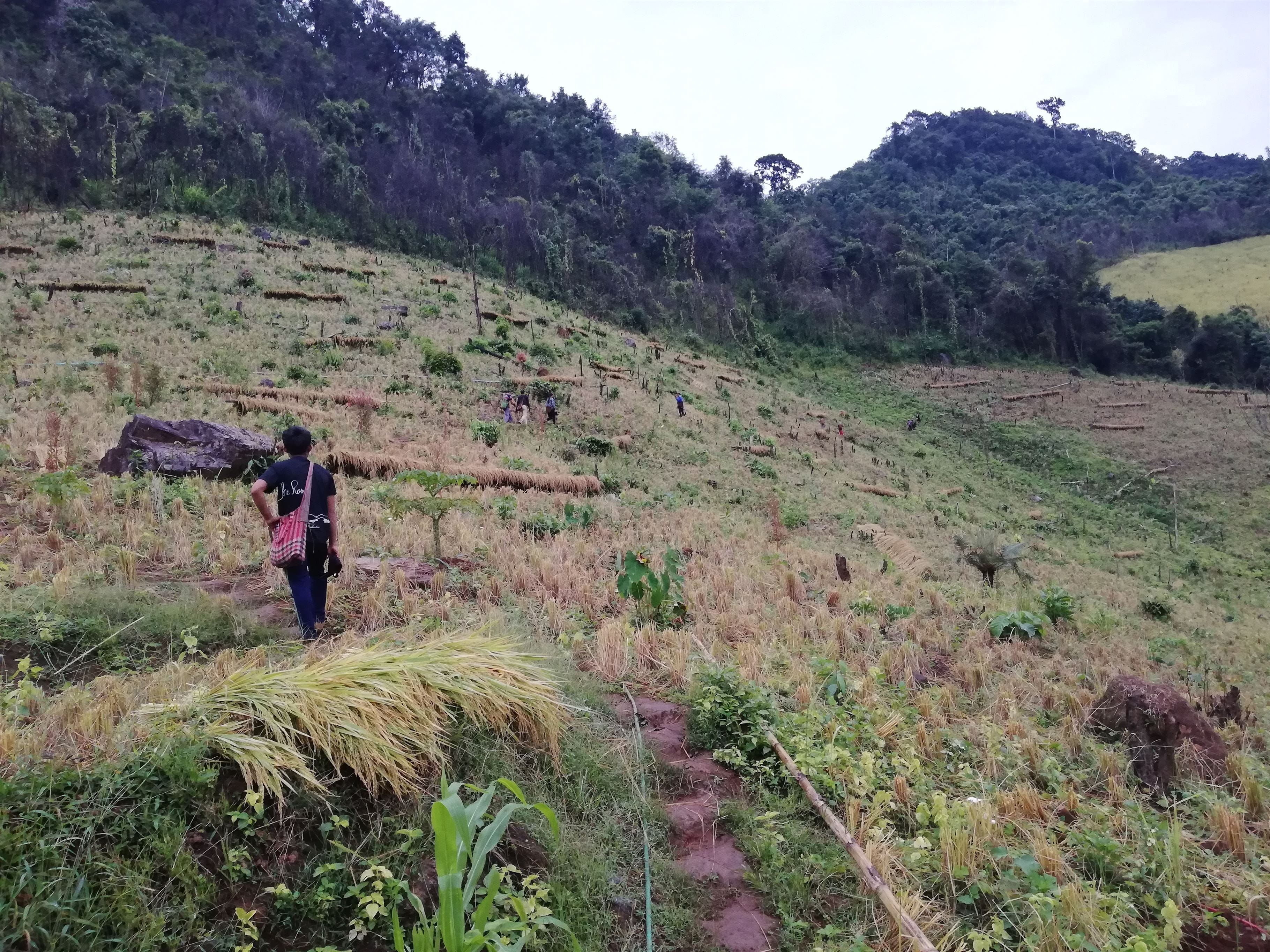
To be fair, as a sort of “anti-profit” project,2 we’ve only survived this far because we have outsourced an extra half-acre (or so) of rice field to Karn’s parents’ farm, who supply us with a few bags of rice per year in exchange for Karn’s help with the annual harvest (and sometimes the planting), as well as seasonal shipments of fruit and wine.
The whole endeavor was her idea, and from inception to execution she took the lead, repeatedly asserting herself against the owner of the land, who is not only fifteen years older but the patriarch of a rather conventionally-minded family.
The arrangement was simple: we supplied most of the initial work of clearing the land and preparing the soil, the rice planting is done together, and every consecutive task is done by us, with occasional help from our friend and/or his wife according to their availability.
Given that we are still in our physical prime, don’t have additional mouths to feed or bills to pay, and have more spare time during this part of the year, we gladly bore most of the workload. Our friend has a small excavator business to run – their main off-season source of income – and his wife has to take care of their one-year-old daughter.
This was a promising opportunity for us as well, since our land is too small (and far too densely planted with trees) to do experiments like this on such a scale. Moreover, we had a chance to grow out “dry season vegetables” (who don’t grow well during torrential rains and scarce sunlight) and thus save plenty of seeds to replant and share.
We sourced all three varieties of seed rice – Thai jasmine rice from Karn’s parents, purple sticky rice from a friend (traded for our mangosteen), and hill rice from the Pakagayaw – and our friend supplied organic & inorganic fertilizers. Any yields would be split evenly and/or according to need.
And in addition, we were allowed to diversify the plot through interplanting various vegetables that are commonly cultivated in the swiddens of Southeast Asia’s traditional shifting cultivators.
Due to a variety of factors, our expectations were rather low. First off, we were the only ones in our entire province that planted rice, and rice as a staple works best if there is such an abundance of grain that even heavier animal predation doesn’t diminish overall yields.3 The few people we know who tried planting rice in recent years all reported catastrophic losses due to birds (although their plots were much smaller than ours). Second, when we started clearing the land all our rice-planting friends and relatives had already finished planting, and by the time our rice had sprouted, theirs was already standing tall. We knew we were late, but nonetheless thought it might be worth the effort. As Daniel Quinn said, starving people don’t invent new subsistence modes any more than people falling out of airplanes invent parachutes, so it is best to use every opportunity to experiment before supply chains collapse and harvests fail.
Other villagers shook their heads at yet another crazy idea of those two hillside hermits, and Karn’s mother laughed out loud when we told her that we would grow paddy rice on a hillside (a telling reaction). But, since our rainy season is usually (!!!) a bit longer than in the North and Northeast, we thought it might still work – that is, if the Thunder Beings are merciful!
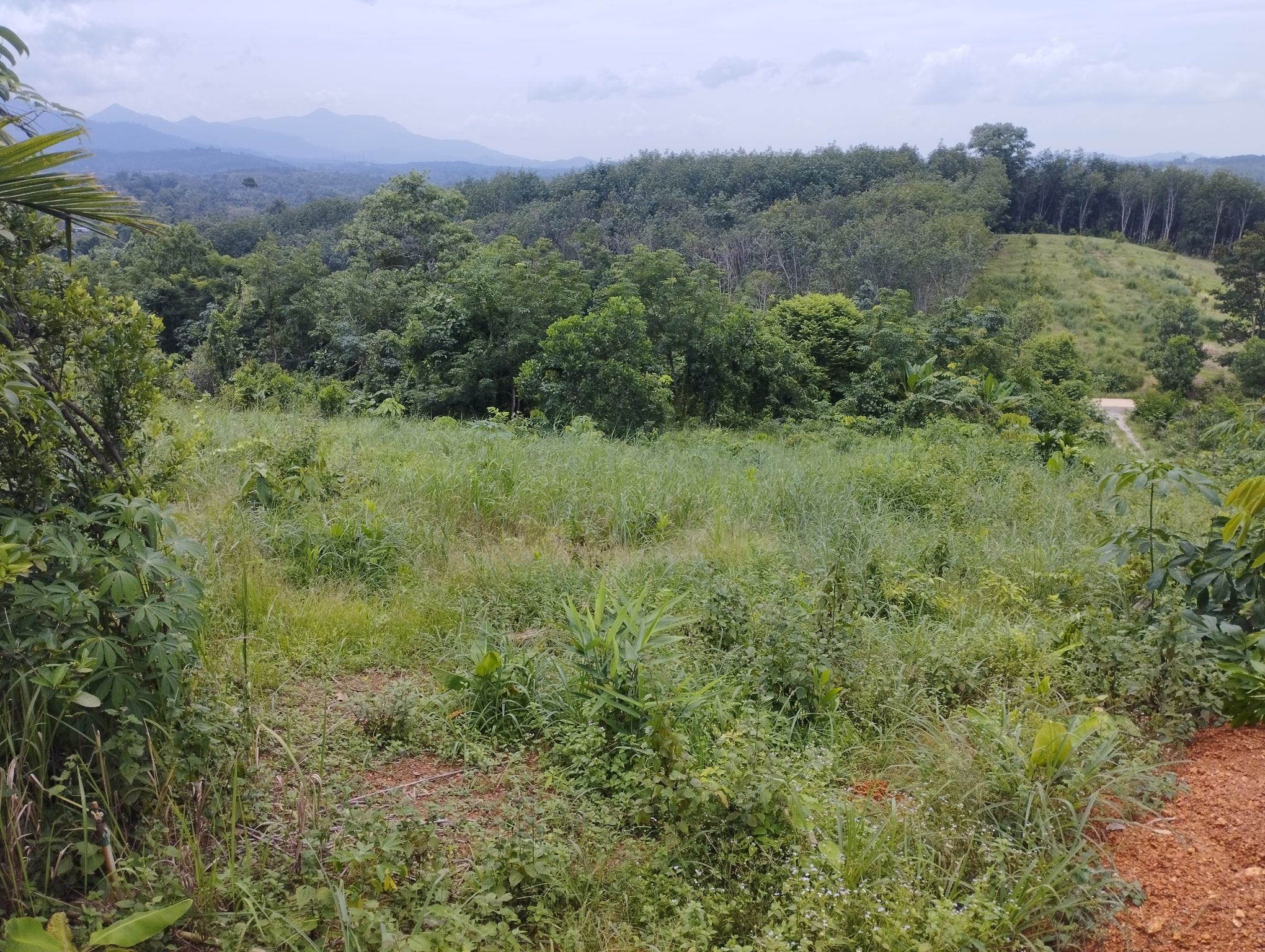
After selecting a suitable site, a gentle, Northwards-facing slope situated on a low hill about a ten-minute walk away from our land (or, alternatively, 1.5 km by motorbike – there is a shortcut which is too steep for a motorbike with two people on it in rainy season), we were eager to begin. Time was running out.
The plot in question, about a third of an acre in size, used to be a rubber plantation, but was logged about a decade ago and consequently turned into a near-fallow field with mixed herbaceous pioneer vegetation (mostly “Communist grass” [Cenchrus pedicellatus]4 and Siam Weed [Chromolaena odorata]) that was in many places higher than me, bordered by dense patches of lower grasses. A year ago, our friend had already planted “egg bananas” that we only discovered, one by one, during the initial clearing. He was surprised they even survived.
The soil had been pesticide-free for a little over a year (although it gets some drift from the adjacent durian plantation), and included various textures and compositions. Most areas were light brown or red laterite clay, but with a slightly higher sand content when compared with our garden, and a few areas where logging slash was burned a few years ago were rich and black. Some corners were eroded down to the subsoil and accordingly rocky.
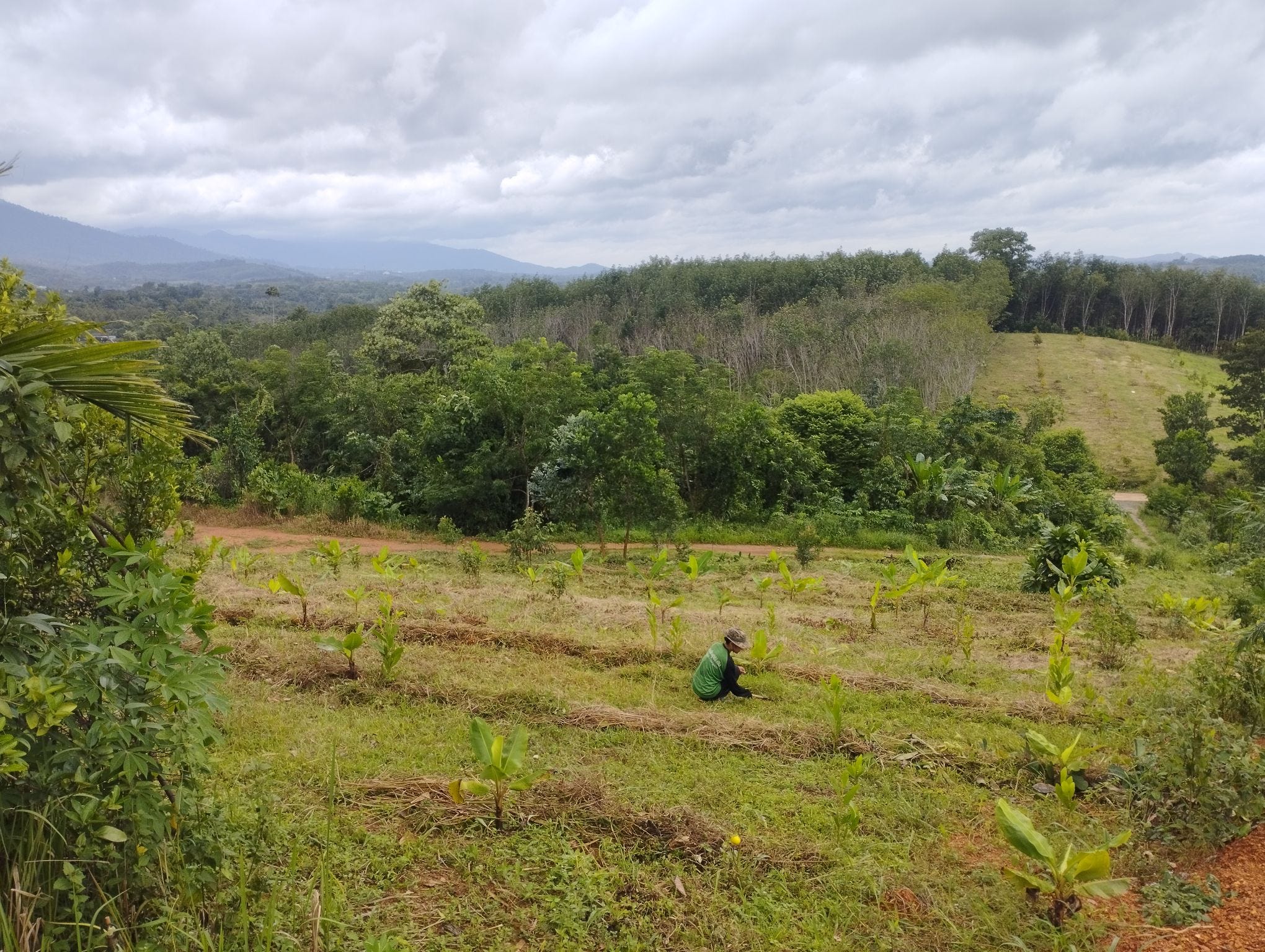
After cutting the grass (with hand sickles, not as our friend suggested with a weed whacker5), we heaped up the grasses in contour lines along the slope, in line with the small banana plants.
Since there was no shortage of work in our own garden during the preparation phase (which was also the height of fruit season), we visited the swidden only for a few hours each time, and often ate lunch or dinner with our friend and his family. In the breaks between working, we could play with the children of the household (who soon developed a keen interest in what we were doing), which was a very welcome change after not having been around kids for several years.6
Initially we still wondered whether we could burn the hay once it was dry, but by then rainy season was in full swing, so burning anything was out of the question.
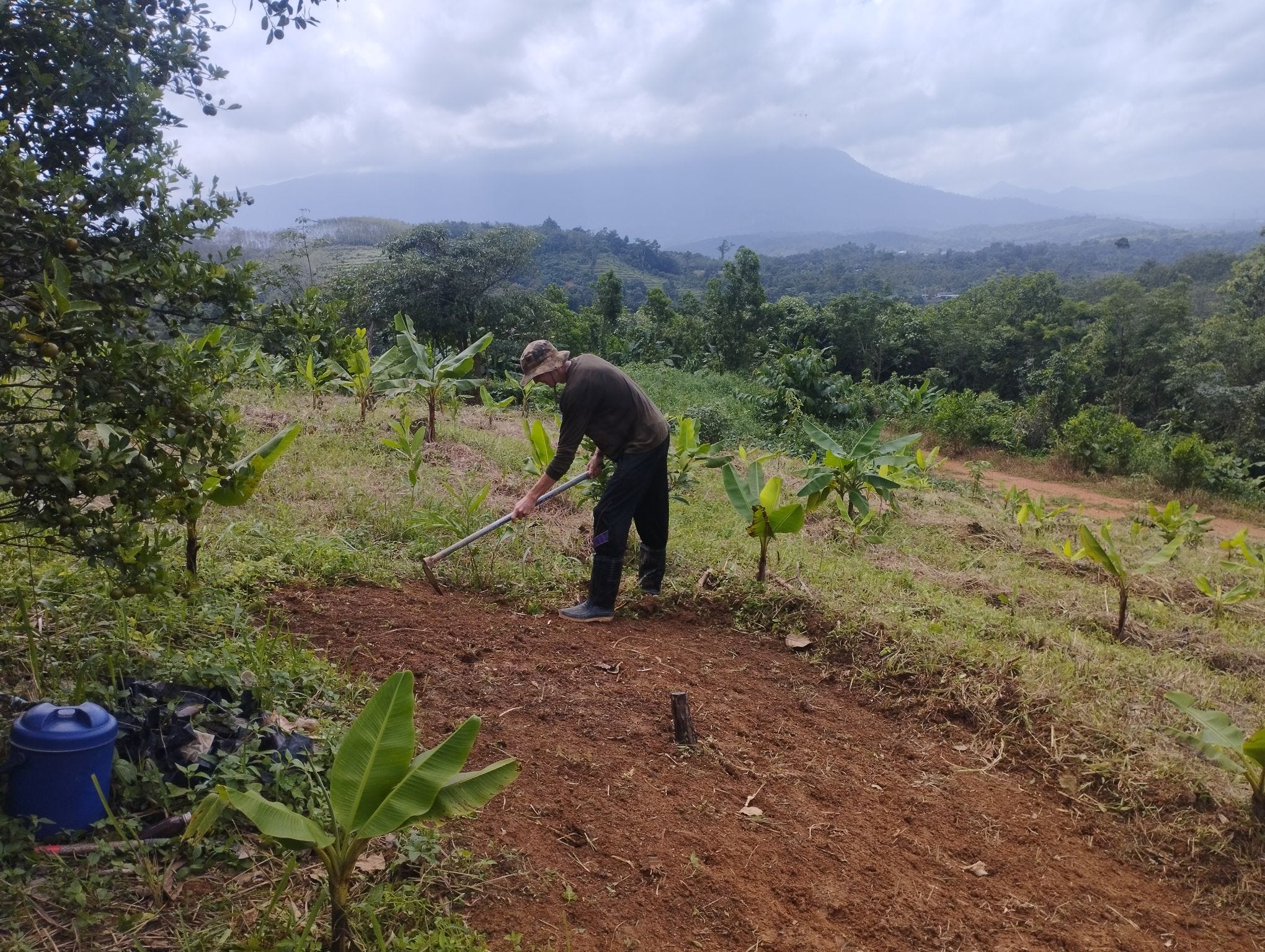
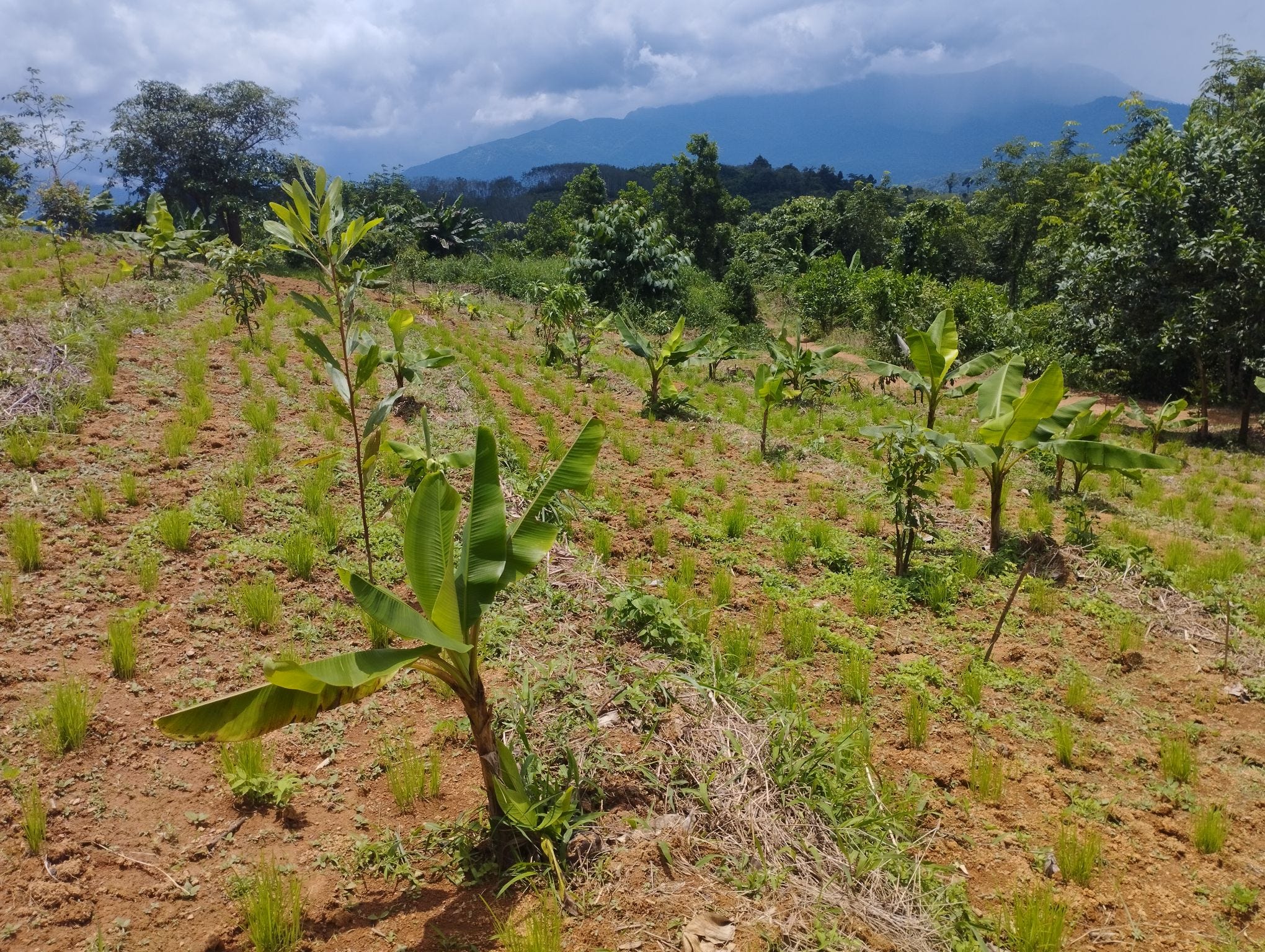
Against the advice from our friend to spray the entire plot with glufosinate-ammonium once to retard initial weed growth, we simply hoed the topmost few centimeters of soil, creating neat rows along the slope to slow down runoff and catch sediment along which we planted various vegetables. To stabilize the rows we carried half-burned logs from an old burn pile at the lower end and reinforced them wherever needed.
If it would have been our own land we would have spend considerably more time and effort on this task, because the long-term benefits of preventing erosion are definitely worth it. But since nobody else values topsoil and we weren’t sure how fruitful or permanent our cooperation would prove, we were reluctant to invest too much time.
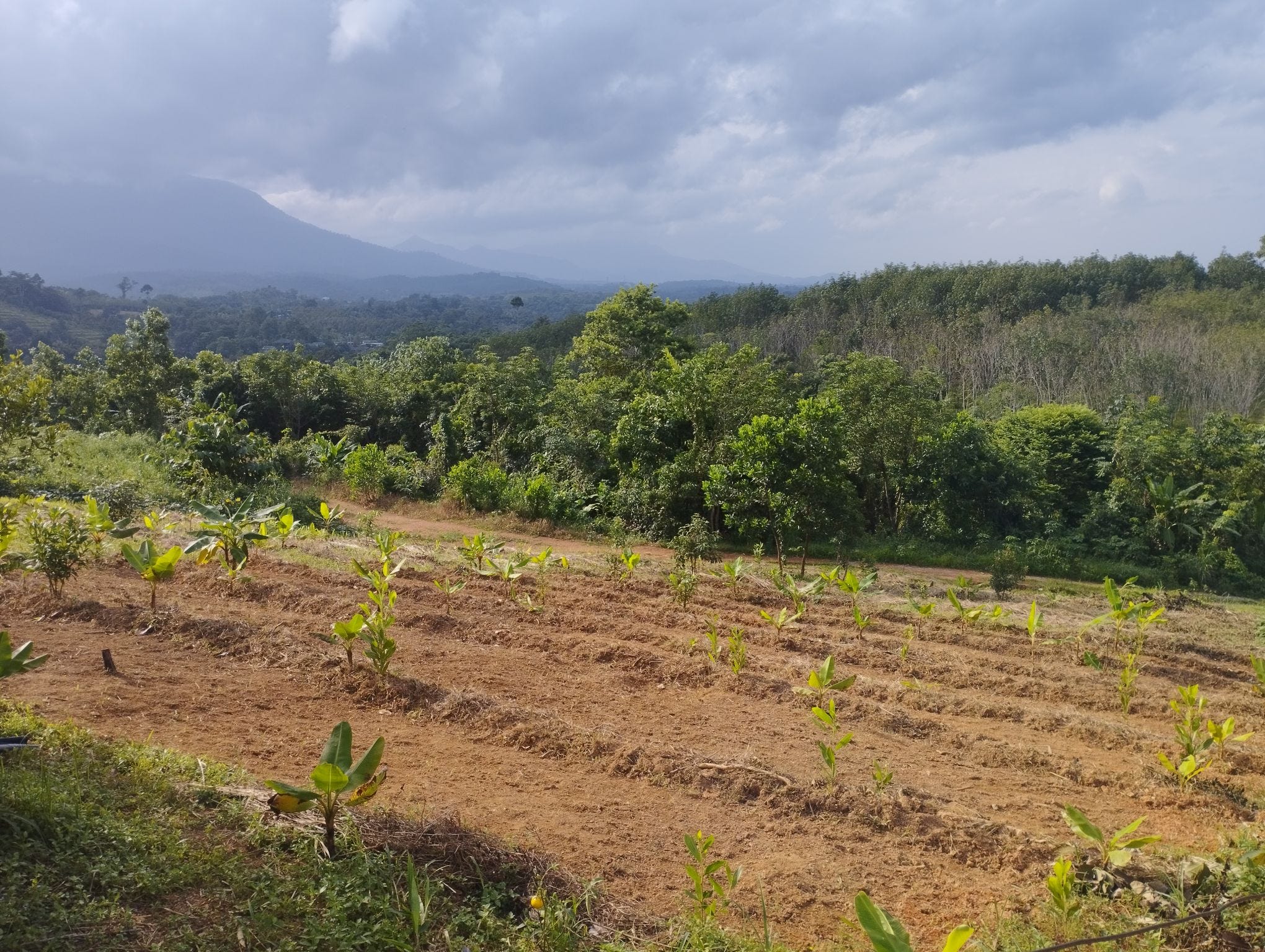
The first challenge was the weather: usually, we get good rain in May and June, then a phase of slightly less rain in July, after which we barely see the sun until the end of September. To our luck (both good and bad), the “little dry season” was postponed until early August last year, giving us enough time to work the land without constantly getting drenched. Especially hoeing is considerably more tiring if the soil is wet and sticks to the tool. There were occasional downpours, which immediately showed the benefits of the layout we chose for the land:
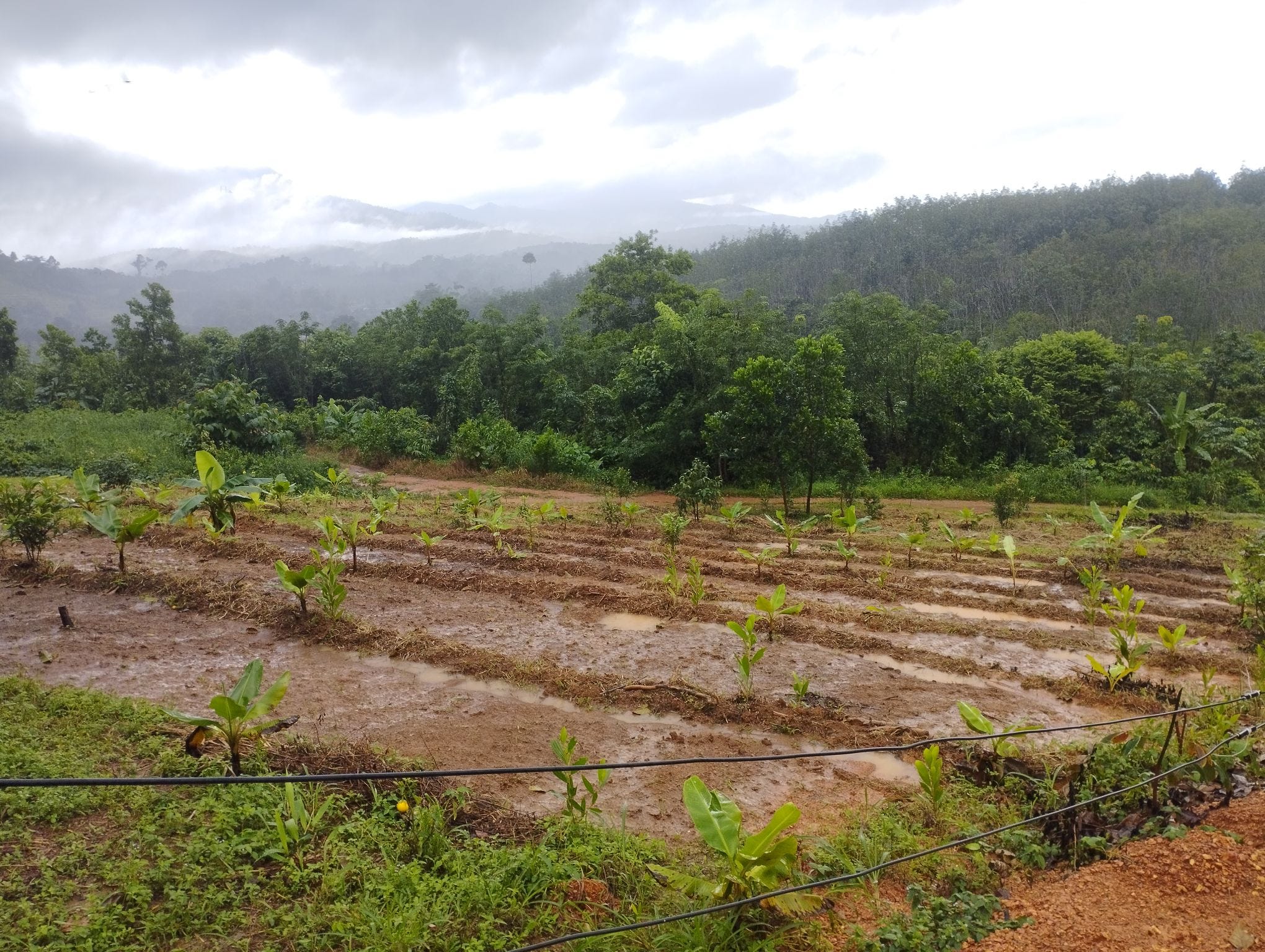
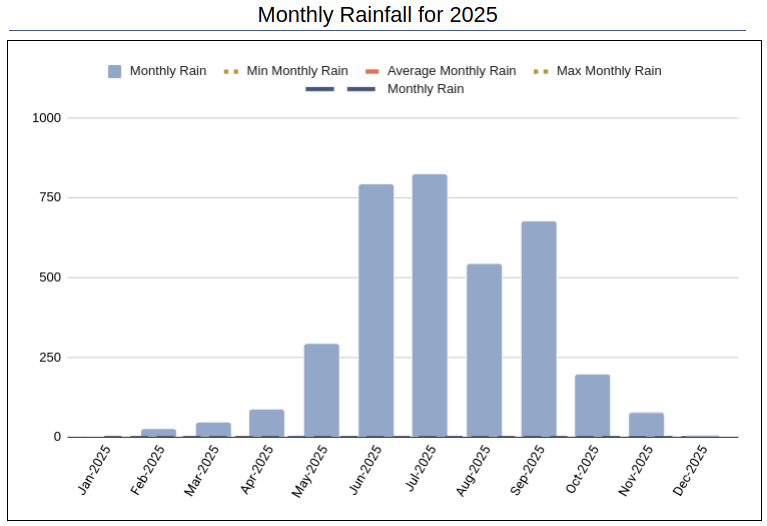
But we bet a lot on August and September being the rainiest months, and, as it turned out, the odds were stacked against us.
For the first time since we moved here seven years ago, the heaviest rains were in June and July, while August & September were unusually dry.7
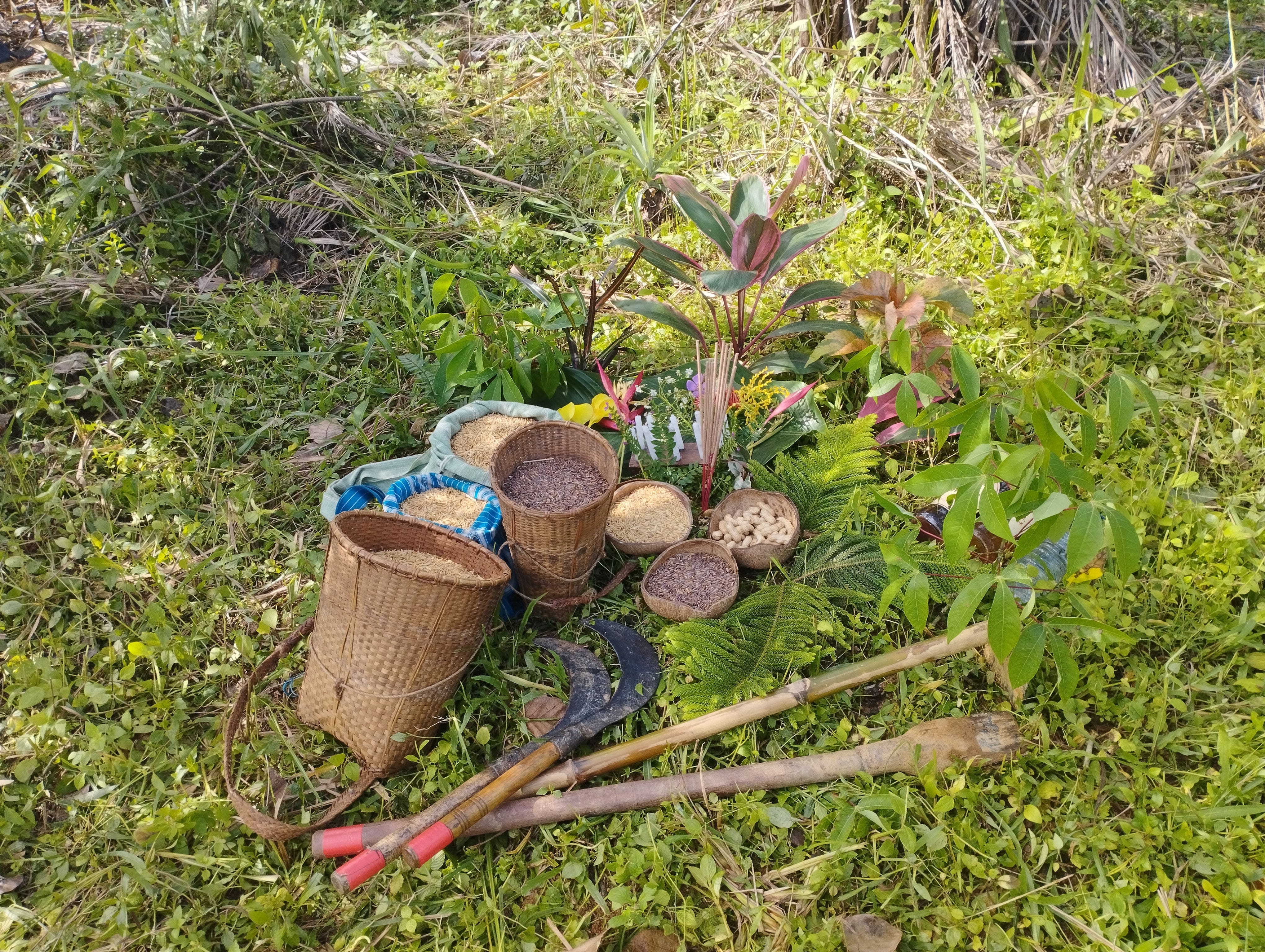
Once the land had been cleared, we spent three sunny days in early August planting rice, first digging small holes to loosen up the compacted earth and then sprinkling seed into the softened soil before gently closing the hole with a swipe of the foot. To be sure to give the rice the best head start, we chopped the soil in each hole into smaller pieces, which was considerably more work than simply punching holes into the soil with a sharpened stick, as traditional swiddeners do.8
Rice planting happens on a spectrum of disturbance with scattering seed as the least invasive, and tilling the soil as the most destructive. What we did was somewhere in between, since tilling the soil would have not only been too much work for us, but would have made the land prone to catastrophic erosion during the coming months of heavy rains.
In anticipation of severe ecological imbalances (such as predation by rats and especially ants, which are abundant even in the most polluted orchards), we were extremely generous with the seed rice, planting about twenty to thirty seeds per hole (i.e. a small handful). As it turned out, our worries were entirely unfounded: there was (perhaps due to already low levels of biodiversity) no noteworthy predation by rodents or ants at any stage; four or five seeds per hole would have been enough.
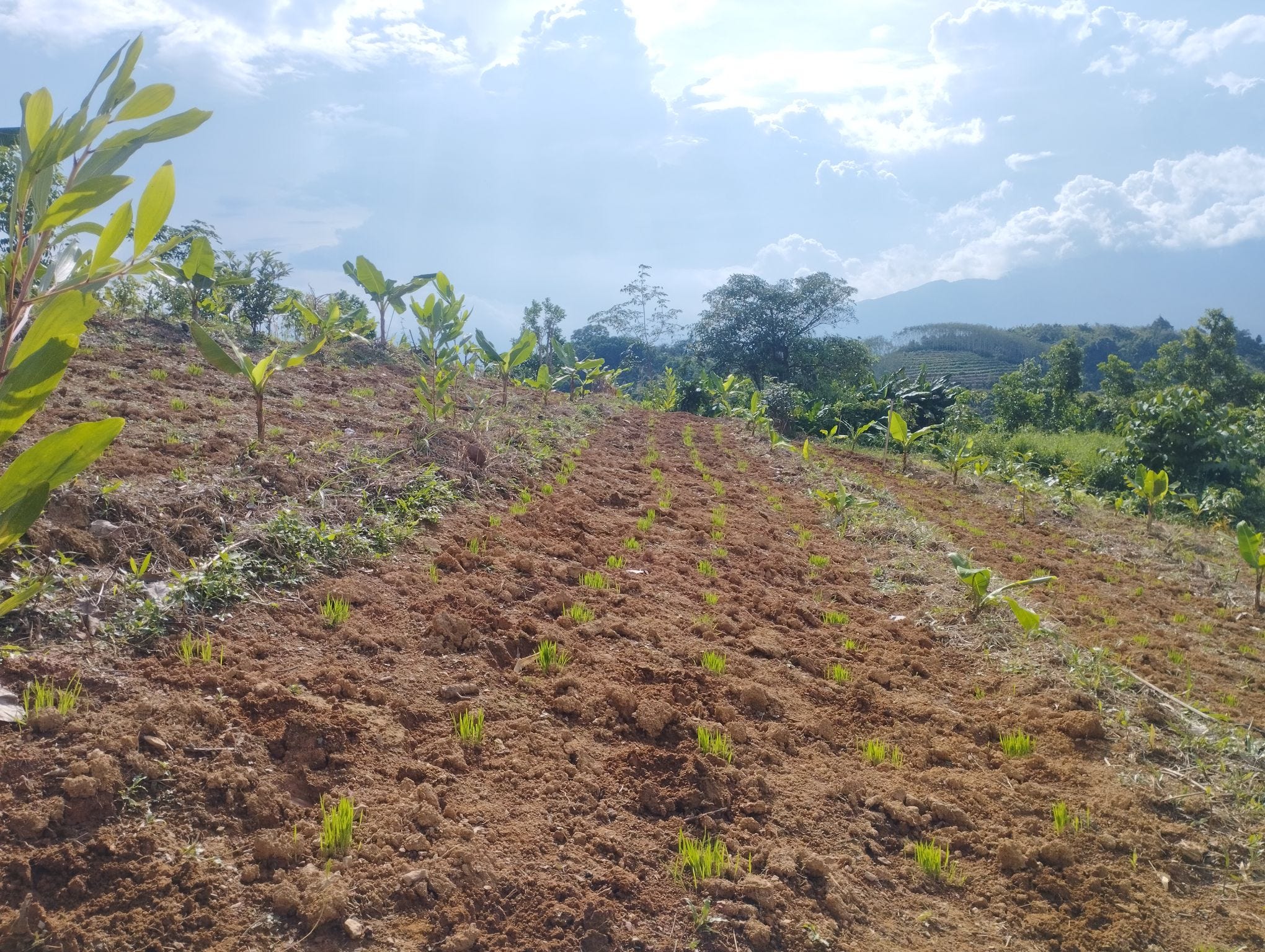
To our great surprise, the rice sprouted very well – a bit too well, one might even say – with the exception of the hill rice.
When we started clearing the patch, Karn’s Pakagayaw friends up North had already planted out all their seed rice, and sourcing leftover seed rice proved a significant challenge for them. We delayed planting the last third of the plot in order to wait for the hill rice seed, and consequently, it was sown a few days later than the rest. Just when we were about to plant more Jasmine rice instead, the parcel from our friends up North arrived, but a few more days without rain meant that germination was delayed even further, even as the other two kinds already sprouted.
Once it became clear that the hill rice had failed to germinate, we started transplanting rice seedlings from elsewhere. Since each hole was hopelessly overcrowded with tiny rice seedlings, thinning would have had a beneficial effect on the rest of the field as well, but we were keen to see the difference. Transplanting was considerably more work, but due to the small scale of the experiment not too discouraging to give it a try.9 After all, what we were doing was mainly an experiment, so adjusting and comparing as many variables as possible means better end results.
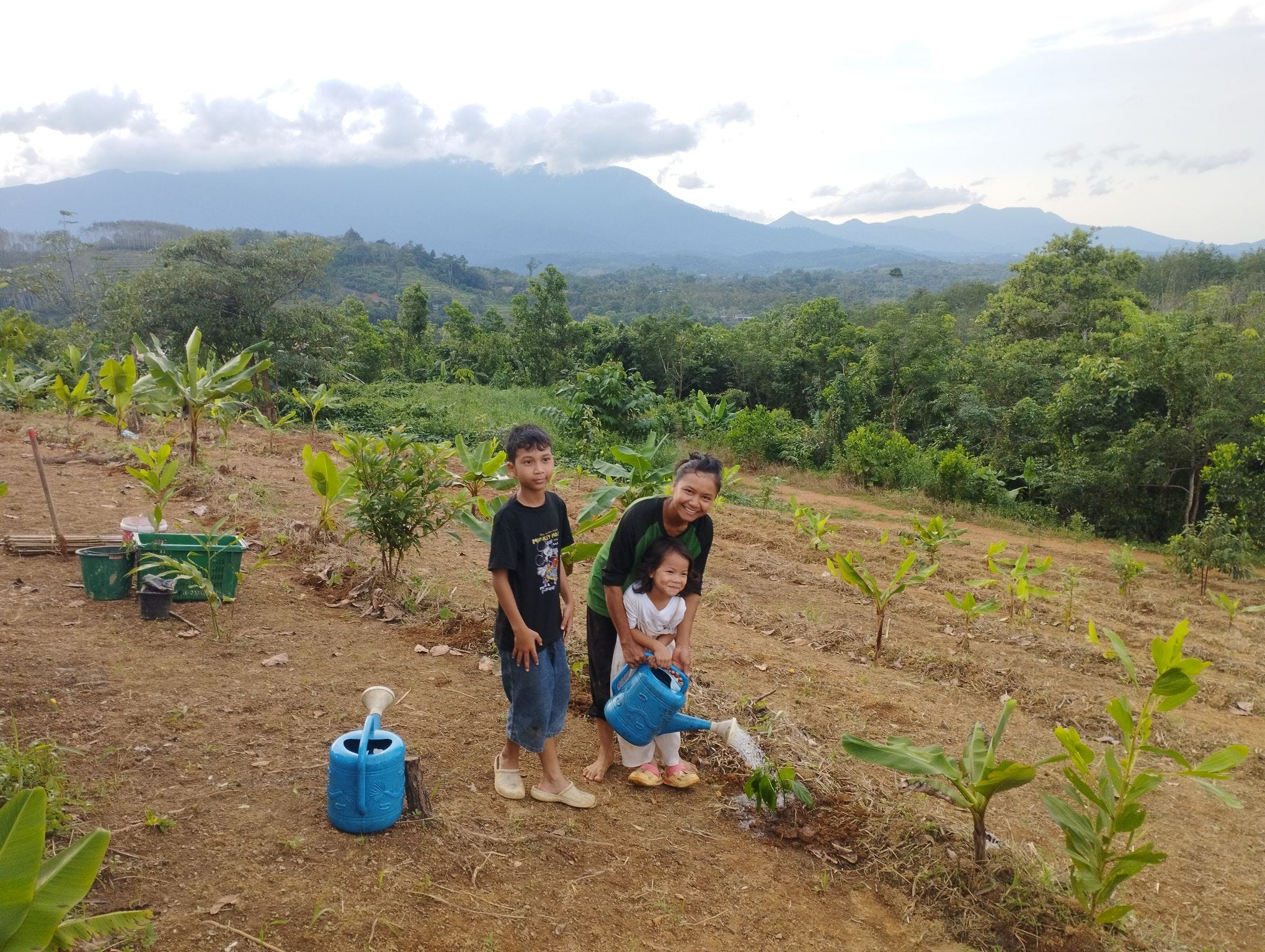
In the meantime, we had interplanted a wide array of vegetables along the contour lines, around rotting tree stumps, and in patches with carbon-rich soil from previous slash burning: eggplants, chili, pumpkin, corn, vine spinach, tiger beans, winged beans, cherry tomatoes, and several other (semi-)wild greens & herbs.
Surrounding the field – as a favor for our friend – we planted pineapple, lead tree, melinjo, cassava, and purple yams, as well as various kitchen herbs closer to the house.10
Traditional shifting cultivators often mix a variety of vegetable seeds together with the seed rice before sowing. This way you only plant once (“Y.O.P.O.” makes a nice slogan), and both workload and disturbance afterwards are minimal. But this technique requires a lot of vegetable seed and knowledge of the optimal proportions of this mixture – both of which we don’t have yet – so we played it safe and did it step-by-step, with a bit more intentionality.
Following their example, wherever the spacing allowed for it – we experimented a lot with different plant densities for the rice – we planted peanuts, mung beans, millet (which failed to germinate), Job’s tears, sesame, lemon basil and marigold (the latter as insect repellent). In addition, we sprinkled the seeds of edible “weeds” like fireweed (Erechtites hieraciifolius) and Amaranthus viridis all over the field – curiously, most useful non-cultivars are scarce wherever herbicides use is rampant.
At one point, our friend started having doubts as to whether we might overdo it a bit with the interplanting, but his concerns were waved away by explaining that they won’t “compete too much” with the rice, but might actually benefit it since legumes actively enhance the soil, and (wild)flowers might distract predators from the rice. In case they’d completely take over, we explained, we could just hoe them back into the soil as green manure.
But since our cooperation involved no monetary transaction whatsoever, he didn’t have the leverage typical for farmers here, which – together with the slight bafflement this novel situation sometimes caused him – was in turn delightful for us to witness. When he told us that “this [or that] young tree can be removed as well,” we could simply smile and tell him “no,” followed by an explanation of the plant’s benefits and uses, and a short, friendly sidenote on the importance of Diversity as a general principle of Life.
«ความหลากหลายคือความปลอดภัย – “Diversity is Safety” [in Thai it rhymes]. Should the main crop fail, there are others to fall back on. Also, there are no monocultures in Nature. Nature always strives for more diversity, so if we try to reduce diversity in favor of a single crop, we are working against her, which means more work for us.»
If we were paid farmhands, we would have had to obey his indirectly implied order meekly. But this hierarchy had been dismantled – if he wants free help on land that’s too large for his family to cultivate alone, he would have to make compromises with the people who provide the crucial extra pairs of hands.
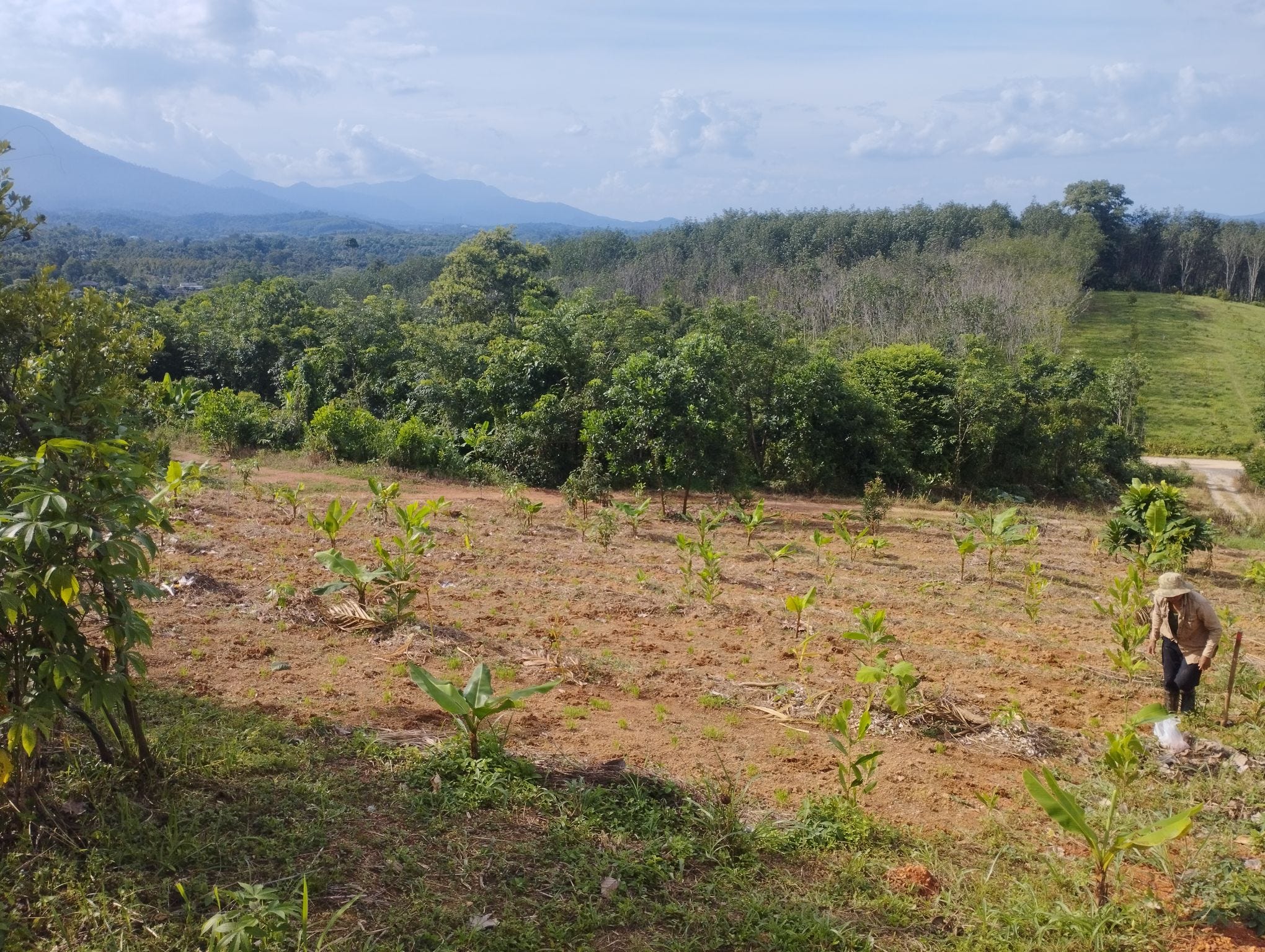
To give the young plants a little initial boost, we used composted, EM-enriched cow manure once they sprouted, then fertilized again with a pinch of compound fertilizer (15-15-15; “สูตรเสมอ”) when they reached a hand-span’s height, and one last time with bat manure when the rice was in its “pregnancy” (the phase when the stalks start swelling up).
Again, had we slashed and burned the field, additional nutrient requirements might have been a bit lower.
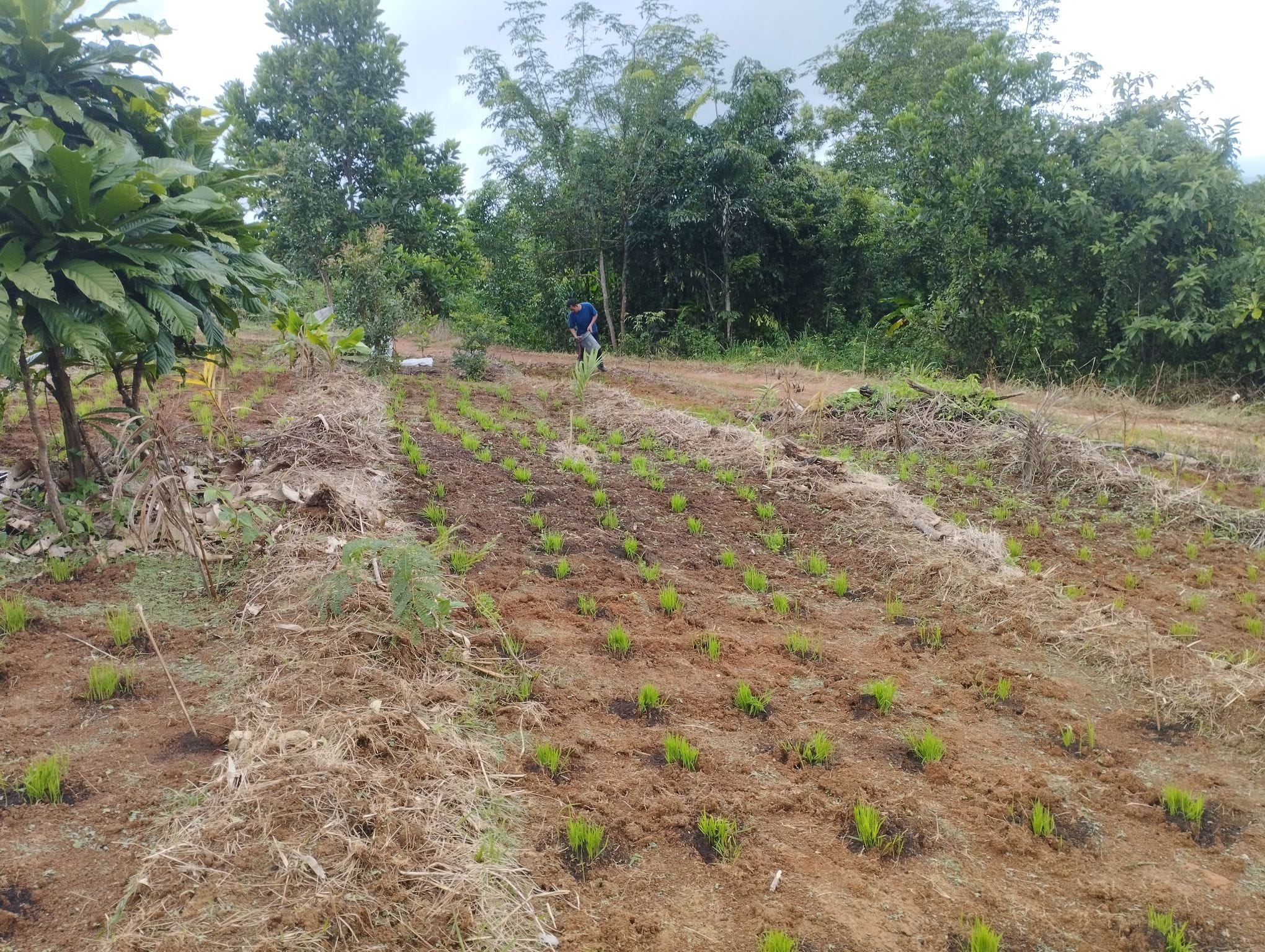
Once that was done, there was little else to do besides wait – and pray for more rain.
At this point, our friend’s biggest worry was competing “weeds” – a common myth perpetuated by BigAg to sell more herbicide – yet ground vegetation regrowth was negligible even two weeks after the rice had sprouted. People’s ideal rice field is one devoid of any other vegetation, and the soft green carpet that had started to cover up the soil irritated him considerably.
«A common misconception of conventional agriculture is this: plants are believed to be in a constant all-out war over resources like water and nutrients, and only by systematically exterminating every potential competitor does the target crop produce abundant yields. People blast their orchards with herbicides because they fear that tiny grasses will “steal fertilizer” from their durian trees. Obviously, this makes no sense – what do they do with those stolen nutrients, run away? Squirt them into the air? No, they are simply stored within their bodies, accumulated, and then returned to the soil once the plant decomposes.»
Following the example of the hill tribes, weeds growing between the rice stalks were slashed by hand two times, and we did occasional spot weeding when tending to the interspersed vegetables or walking through the field.
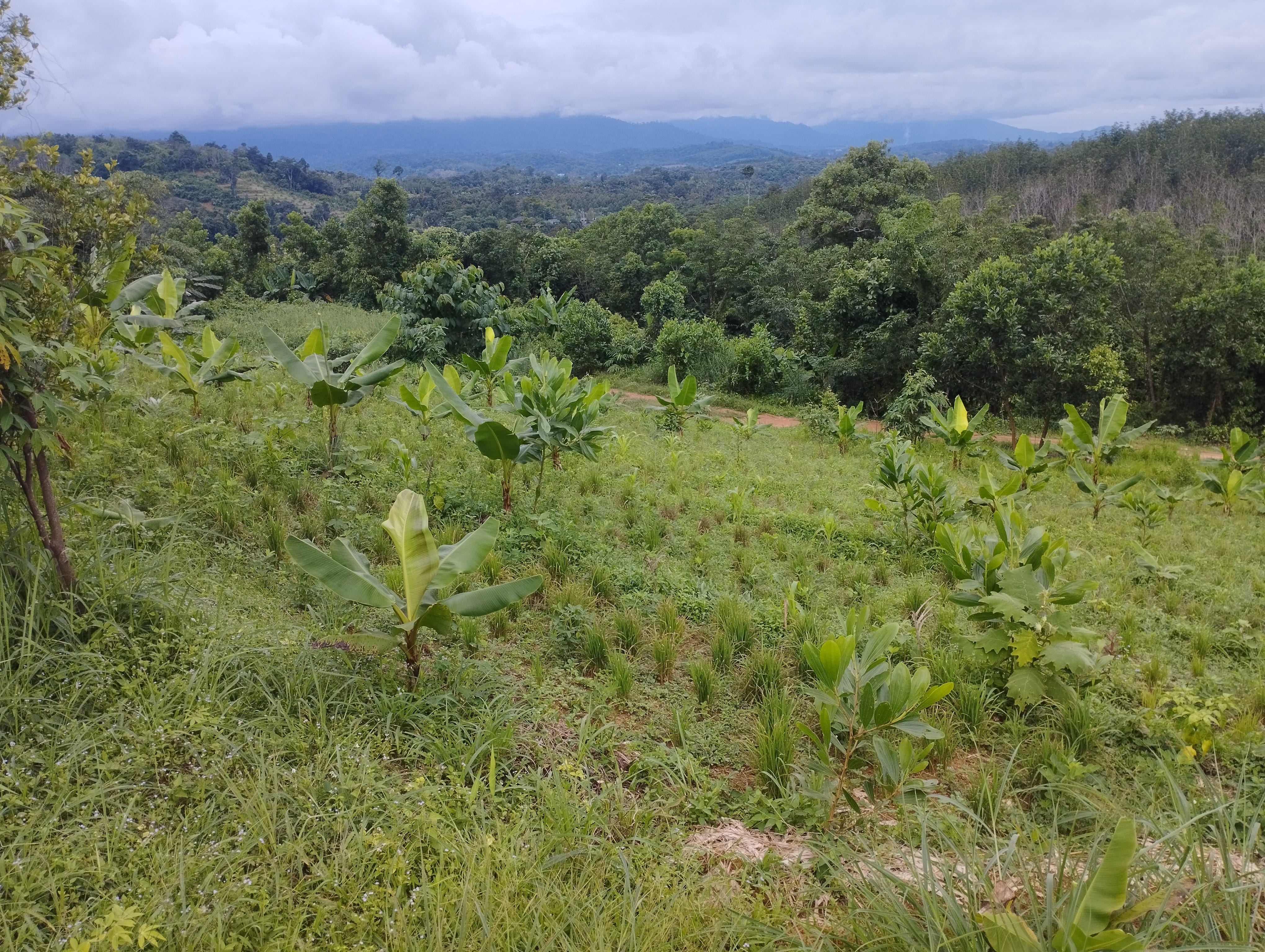
Then, one fateful September week, calamity struck. While I had urgent matters to attend to in the capital,11 an infestation started spreading throughout the patch. First it was only a few clumps of rice that suddenly had wilted or dry leaves: those right next to the adjacent durian plantation. Within a few days, the majority of plants was affected.
Karn suspected that it might be rice thrips, a common pest during dryer periods like the one we were experiencing. The lack of rain wouldn’t have been much of an issue for paddy rice, but since our rice was exposed on a hillside, the unusual August dry spell proved (near-)fatal.
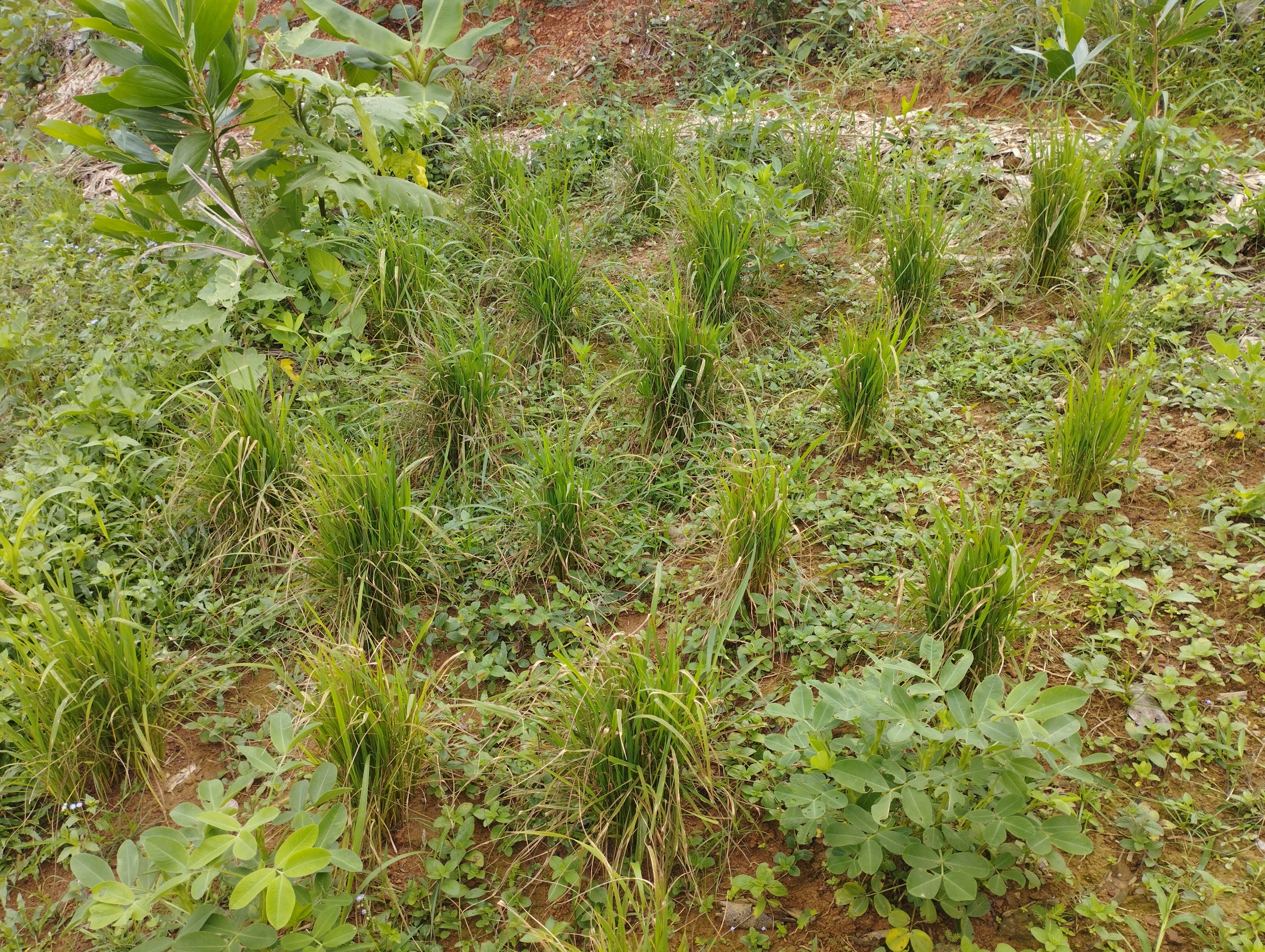
Ultimately, about half of the infected rice plants pulled through, but the fight against the disease had cost them valuable time. And while some Jasmine rice plants actually produced decent panicles, we decided – without failing to notice the sweet irony – to leave them for the birds.
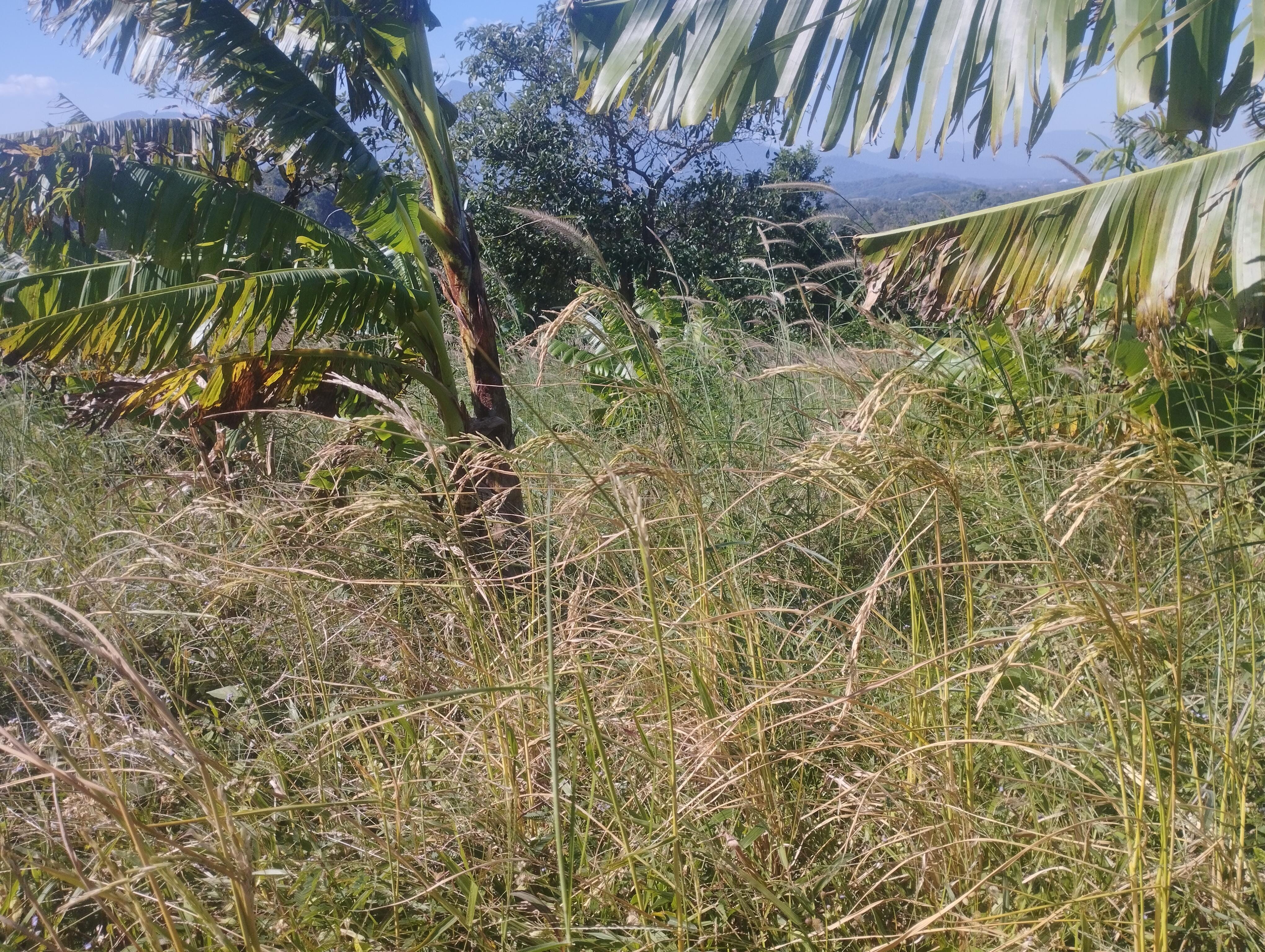
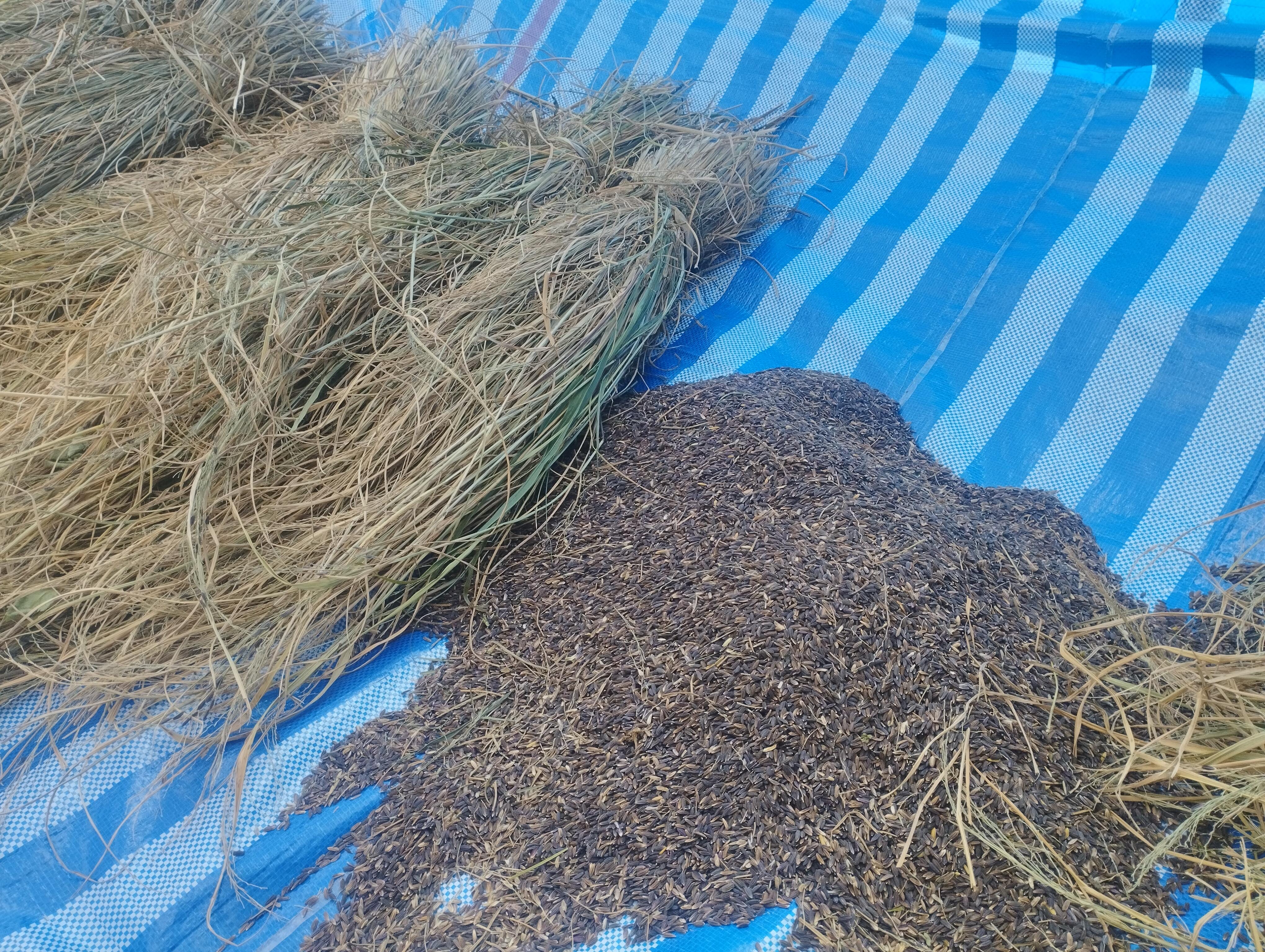
Only the black sticky rice (which seems to have some immunity and grew in richer soil) actually provided a (tiny) harvest, amounting to about half a sack of seed rice for next year after threshing.
Half a sack. I’m reluctant to calculate the EROI.
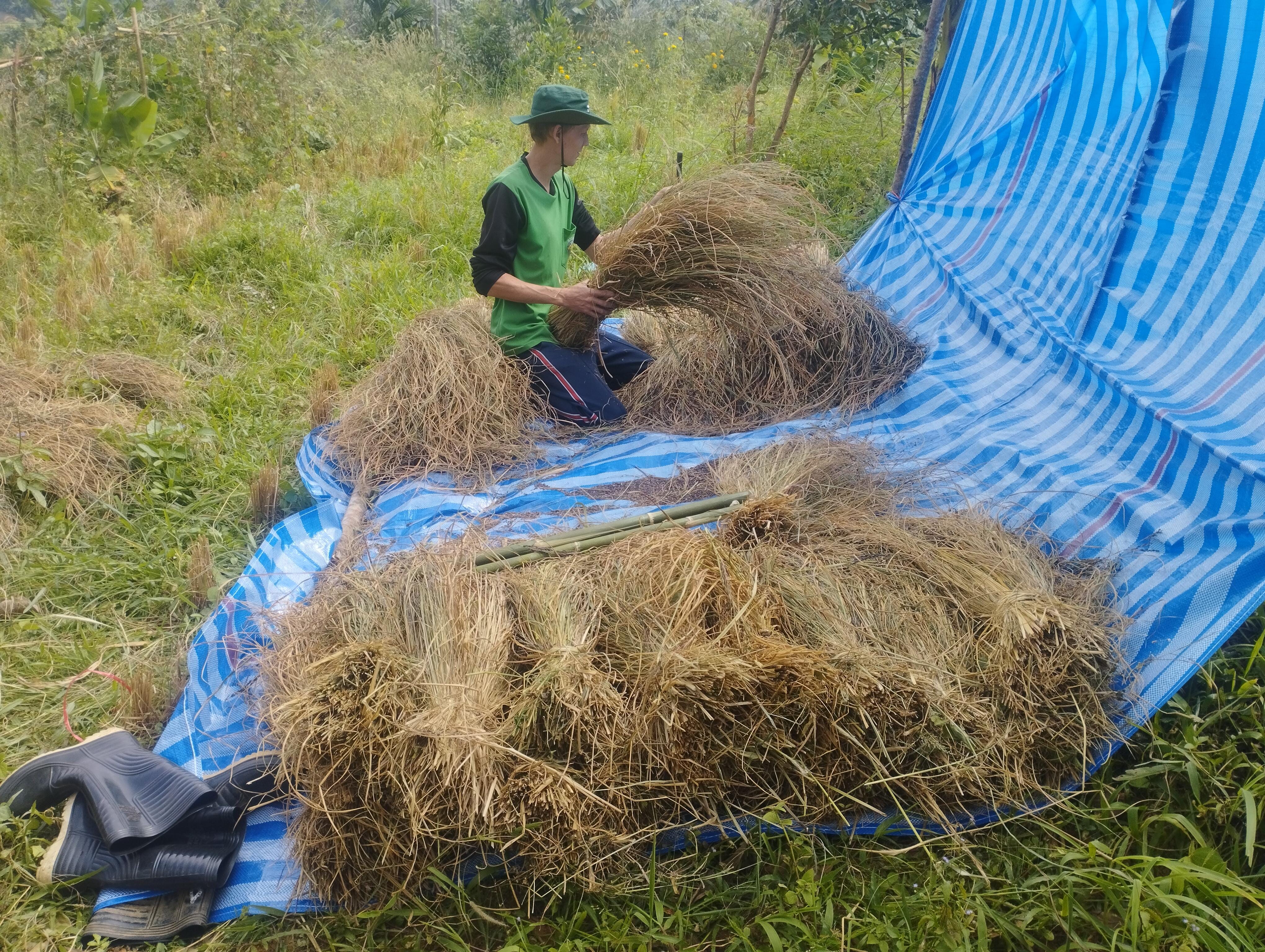
From the perspective of our fellow villagers (including our friend), the endeavor certainly looks like a complete failure. Many didn’t expect anything else, and we sensed a certain subliminal “I-told-you-so” vibe here and there when people smugly inquired about the harvest. Fair enough.
But the project could only be deemed a failure if you think its only objective was the production of rice.
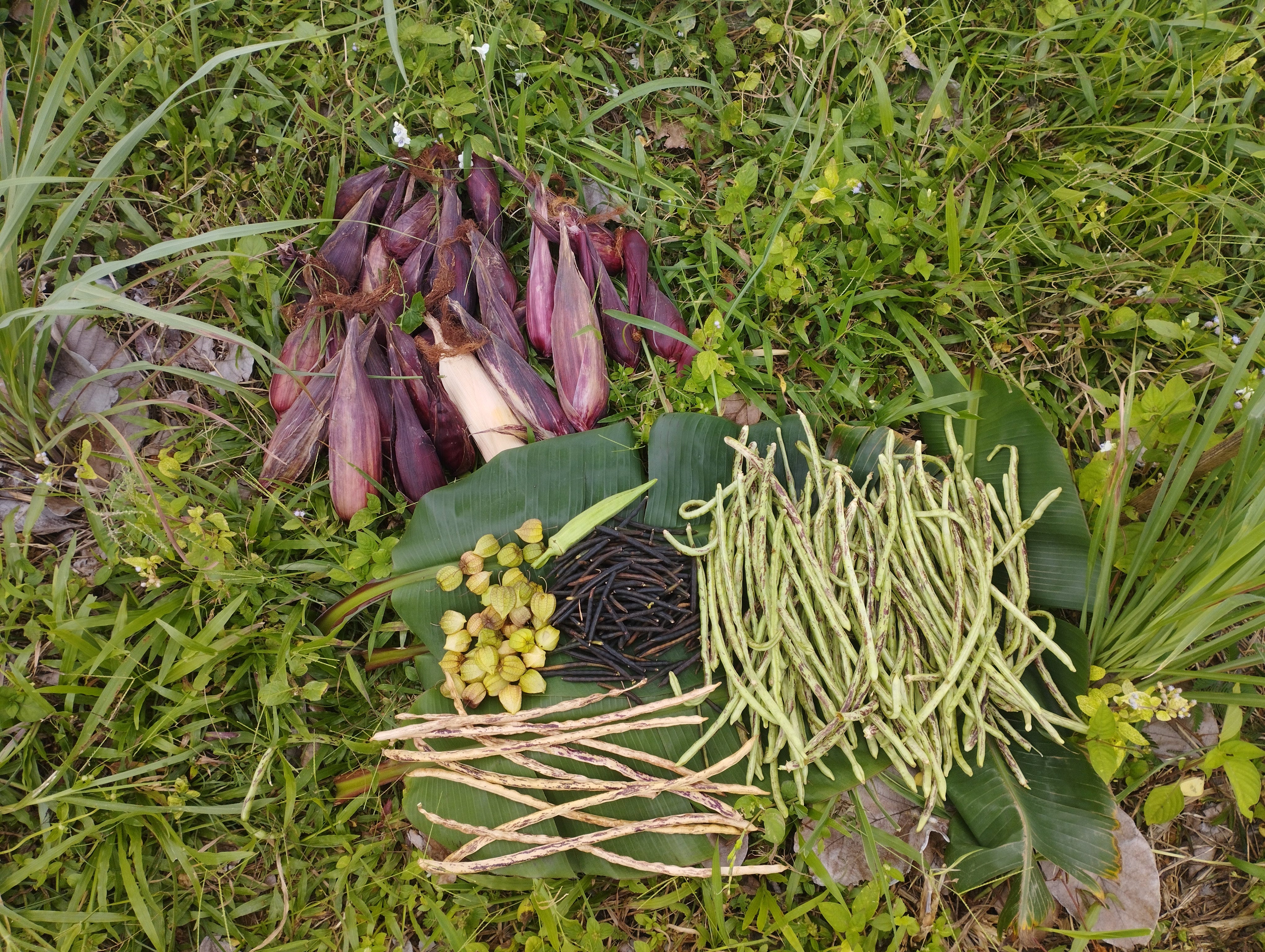
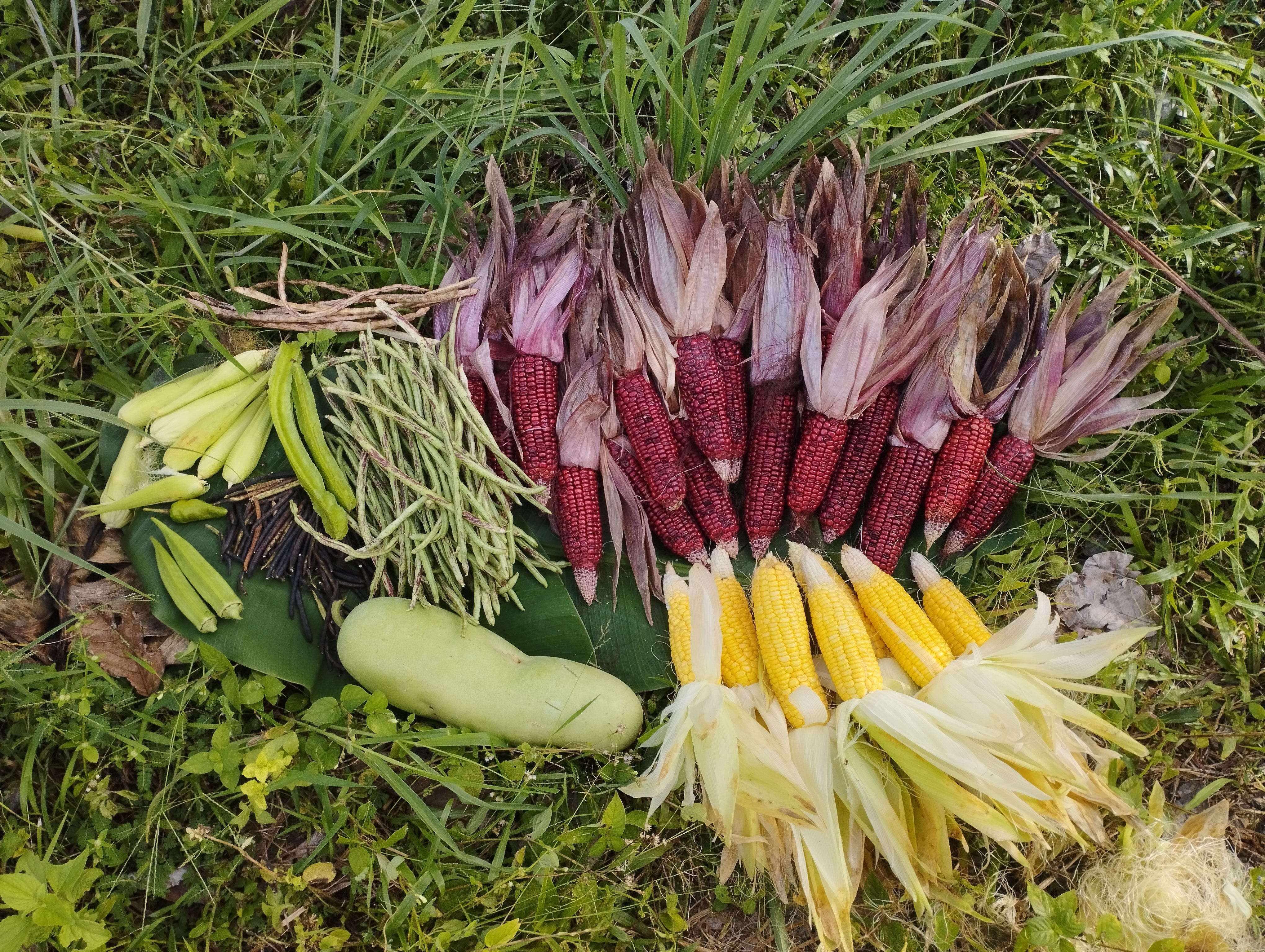
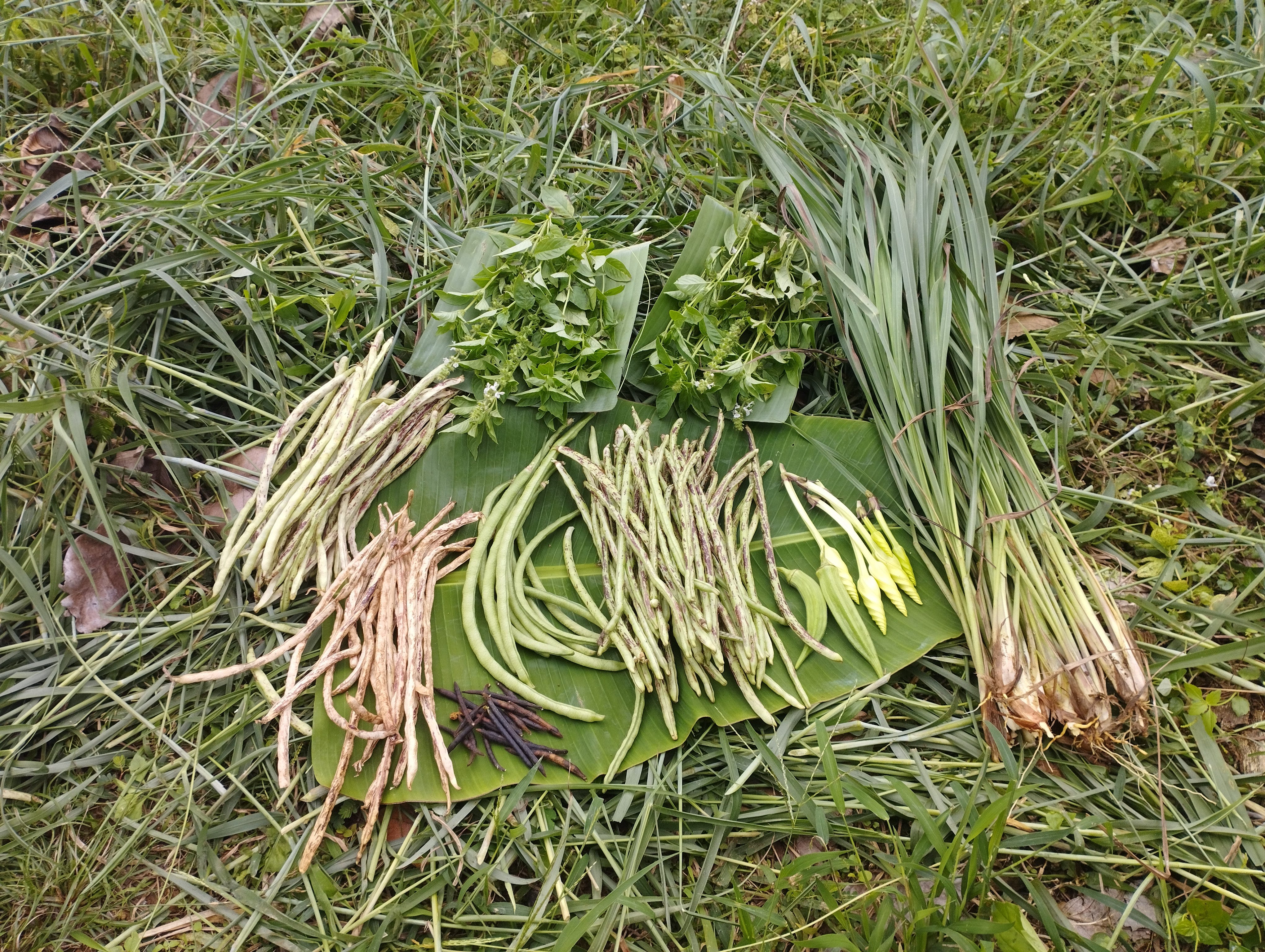
Nonetheless, for several months we steadily harvested an impressive variety (and amount!) of vegetables, greens and seeds. The peanuts we had interplanted turned out exceptionally well, as did the mung beans used for the same purpose. Time investment for those companion plants was minimal, but harvests bountiful.
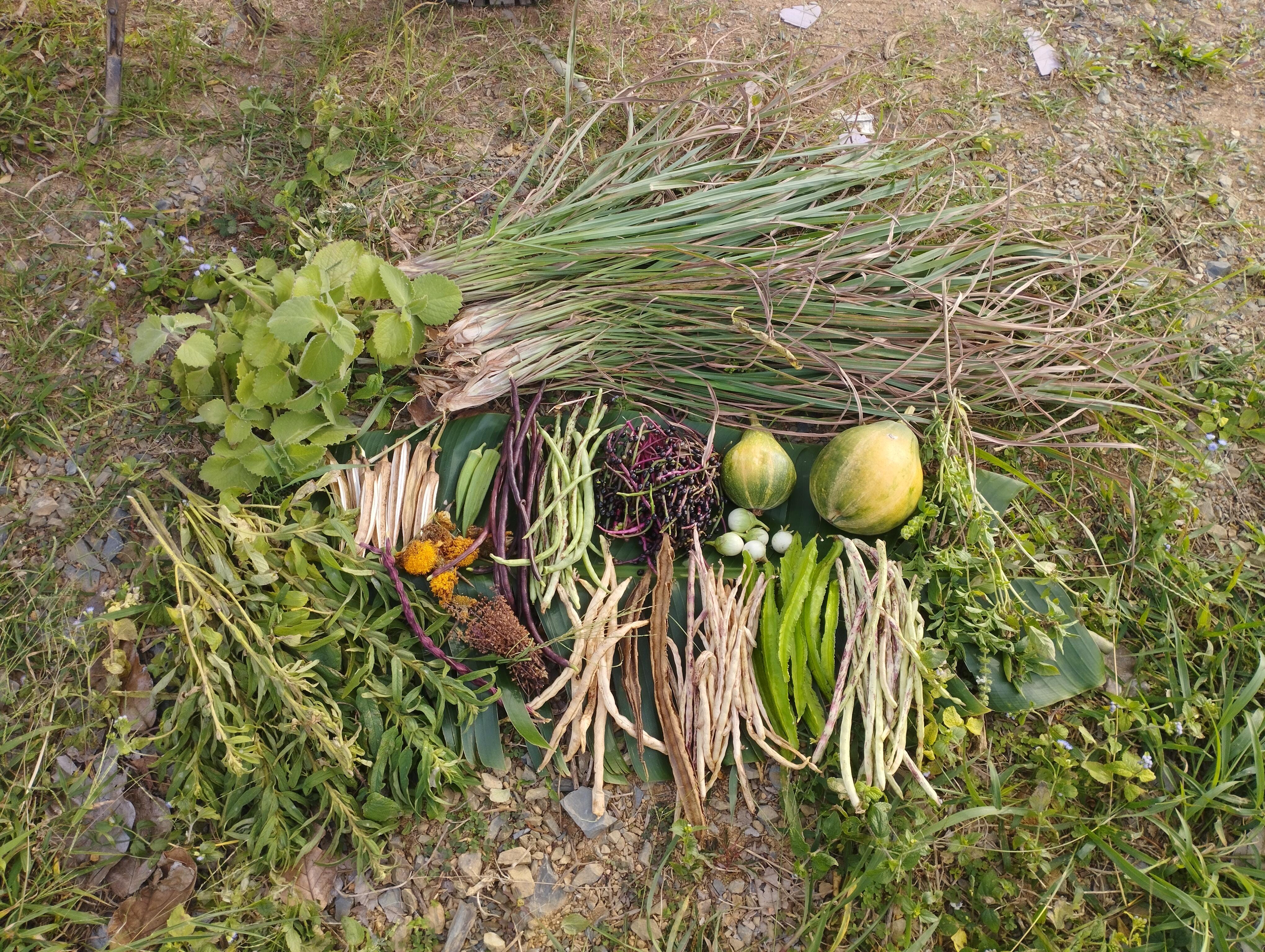
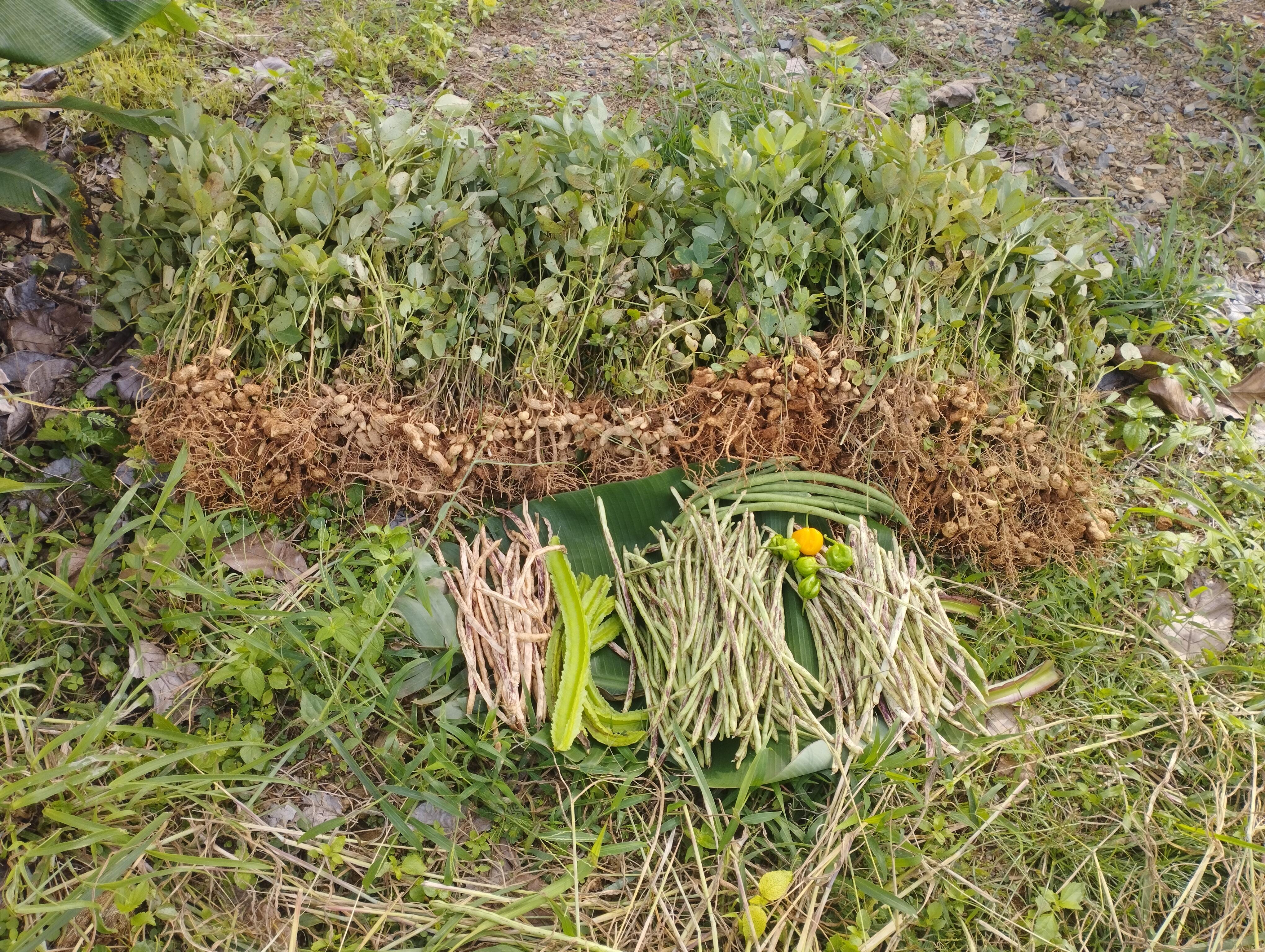
We were humbled, but satisfied. Despite all odds being stacked against us, we had actually harvested some rice. Our failures tend to teach us more than our successes, and equipped with plenty of lessons we now have the best prerequisites for the next round.
After all, it was first and foremost a mere experiment (not a serious attempt to produce rice), and not only an agro-ecological one, but also (and perhaps more importantly) a social one. Right now we are still blessed with enough free time to mess around, because when shortages kick in it will be too late. After all, we are only the first ones trying again.
Unlike our friend, we don’t care much about “losing face,” but, as we reassured him, once people realize they will have to rapidly localize staple food production, chances are high they’ll eventually still come to us for advice and assistance.
And, since nobody else around here plants rice anymore, we can proudly proclaim that our experiment has yielded the largest rice harvest in our entire district – now ain’t that somethin’!
Conclusions
The most challenging aspect of the entire experiment was being confronted with the bulwark of a dogmatic mindset that comes with conventional farming. As mentioned before, grasses – the most normal aspect of any agricultural landscape – are feared by farmers here.
People prefer the dried-up yellow-brownish look caused by herbicides over the lush green of the natural vegetation.
Additionally, every disease or infestation is viewed in isolation, completely removed from its environmental context, with a “bad guy” that needs to be exterminated with the right mix of poisons.two
Virtually all education about farming now comes from agrochemical manufacturers and, increasingly, dubious TikTok influencers advertising (sometimes highly questionable) “planting hacks”12 and/or products (like gardening tools entirely unsuited for tropical soils, or unlicensed pesticides with Chinese labels).
To our species’ great misfortune at this crucial moment in our evolution, old minds seldomly change, so when our friend told us at one point that “next year we might have to spray fungicides”13 to avoid a recurrence of this year’s problems with disease, we seriously started questioning whether this whole undertaking has any chances for long term success.
What. the. actual. f… I mean, what a fallacious and extraordinarily myopic inference.
We started planting a month later than everyone else, into unenrichened red clay (subsoil, really – our friend’s eldest son confirmed that all topsoil on their land had eroded since his childhood), way too densely, with seed rice from other regions (and climate zones) of the country, both of which are used to growing partially submerged.
And the lesson he draws from all this is that we will have to increase pesticide use.
The very obvious main lesson for us was that, if rice is your main staple, even slight variations in the seasonal climate can mean the difference between feast or famine. If you do agri-culture, the most crucial aspect is getting the timing right – which, in turn, is only possible if the seasons are reliable year-on-year. The alternative (tree and tuber) staple crops we cultivate on our own land might barely be bothered by such differences, so for the longer term the direction is clear: less grains, more dietary diversity. Had we planted cassava or cocoyam, none of these complications would have occurred in the first place.
But in the immediate future, rice will still be a necessary stopover staple.
Provided we can come to an agreement with our friend, next year we will a) start earlier (!!!), b) use less seed rice per hole, c) focus on dry rice varieties, and d) dig smaller holes, perhaps using a small spade with a long bamboo handle, like Karn’s Pakagayaw friends. On planting day the soil was dry, so in the future we will try to time it better. Soil softened slightly by gentle rain is a lot easier to work.
Furthermore, we will interplant even more diverse crops, and – if anyhow possible – would like to try burning slash beforehand.14
There is plenty of secondary forest on his land, which he simply doesn’t have the time to tend to. But since he has an excavator, and everything looks like a nail when all you have is a hammer, he plans on using it to clear the vegetation – a practice we strongly advise against. The heavy machinery turns the topsoil into mud (in rainy season) or into dust (in dry season), exposing it to the elements. One heavy rainshower and most of it is gone.15
To make matters worse, he is convinced that one of the reasons for this year’s “failure” was that we didn’t make a large enough upfront investment. Given enough money (and time), he would have liked to install a sprinkler- or drip-based irrigation system for the rice – thousands of Baht and kilos of plastic waste just to correct a mistake that could easily be avoided next year.
But, just like all other conventional farmers we know, he remains confident that you have to use money if you want something. No self-made compost can ever match the immediate effect of YaraMila COMPLEX fertilizer, and what could be done with machinery should never be even attempted manually.
The wannabe-capitalist “business mindset” advertised so heavily by the dominant culture makes it seem like nothing in this world works without using money. “There is no such thing as free lunch” – you either buy the rice straight away, or you buy fertilizers, equipment, gasoline for your machinery, and agricultural poisons. You “invest” money, and it is only then that do you get “returns on your investment.” We tried to explain that, if given the choice between an “investment” (i.e. paying money) and using your own strength (i.e. effort & time), we should always strive to use our strength.
«When money is used up, it’s gone for good. There is no way to get it back. But when your strength is used up, you simply have a good meal and a good night’s sleep, and – voilà – your strength magically returns. This way, even if returns are marginal, you have lost nothing, or at least nothing that doesn’t regenerate naturally.»
It didn’t exactly help that most conventional farmers today know very little about plants (including the very plants they cultivate!), even less about the ecosystem at large, and are often, as I’ve recently put it, niche specialists in pesticide alchemy and part-time mechanics. How immensely helpful it would have been to be able to tap into local ecological and (pre-industrial) agricultural knowledge – we tried in vain to find people who had planted hill rice when it still was more common in the area, but that was over fifty years ago and pretty much everyone who was actually involved in planting is now dead. Some of our friends can remember those days, but they were teenagers or children back then, and thus didn’t pay attention to the intricacies of the process.
Within a single generation, both the rice varieties best adapted to our (very) unique environmental conditions and the knowledge of how to plant them was lost.
We have made it our task (to add to our ever-growing to-do list) to rediscover and restore this knowledge, and this process will inevitably involve some failures. But we’re not willing to give up yet. Far from it.
The fallow parts of our friend’s land have great potential,16 but a significant barrier is working together with people whose worldview is, in many crucial regards, diametrically opposed to ours. He has nothing to lose when teaming up with us, since the plot of land in question would produce absolutely nothing if we don’t help to initiate cultivation. But he’d like to be able to get at least some money next time, at least enough to cover fertilizer costs. But if you plan on selling your produce it has to be large and spotless, and this requires agrochemicals.
Should negotiations fail, we might just intensify efforts on our own land, although open space is scarce and experimental plots will be limited to small pockets of fire-farmed microenvironments dispersed throughout the garden. It would be nice to try on a larger scale again, but perhaps the right time has not come yet. As long as agrochemicals are cheap and widely available, people will habitually insist on using them, and cling to “the old ways” (of the dominant culture) with fanatic desperation, poisoning both themselves and their land with each weekly application.
And we – the only ones that actually want to find a way out of this death spiral – are the crazy ones, remember?
But since we’re not fortunate enough to have any like-minded friends in our district (who share our general worldview, an appreciation for wild Nature and indigenous wisdom), we will have to make do with the people here, for better or worse.
The limitations of our social setting are, to put it bluntly, lamentable. Over the years, it has become clear that the kind of society we’ve moved into is the biggest downside of our lives here. Were we embedded into an open-minded, gentle and land-based community (like the remaining shifting cultivators up north17), we could have a much larger impact, would have far more chances for promising collaborations of all kinds, and be a much more effective regenerative force on the environment.
Conventional fruit farming, on the other hand, is pretty much an industrial job (apply chemicals and kill things), and an increasingly undesirable and unprofitable one at that. None of the children or teenagers we know in the village wants to continue working in a sector that has effectively become an overripe economic bubble. There is no future for export-oriented monocrop durian farming, and, deep down, people know it.
And yet, the much-needed ecological awakening/back-to-the-land movement is utterly inconceivable in the current cultural circumstances, not least because astronomic household debt effectively traps people in a vicious cycle of exploitation.
«Previously, the city kept itself fed through threat, taxation, tithes and trade; in the modern age “the Market” regulates the flow of food to the cities, by creating new “needs” whose fulfillment creates financial dependencies (i.e. debt). If you want a new car, you have to take out a loan. To get the loan, you have to prove your ability to create surpluses (i.e. feed city people). Once in debt, you have no choice but to continue exploiting the land to keep up overproduction, further depleting the land each season and thus increasing your reliance on expensive inputs, just to produce more food for the cities. For this reason, elites, banks, corporations and the advertising industry make sure you always stay in debt.»
What will complicate things substantially is that most people these days eschew physically demanding labor as good as possible, and in developing economies farm work is increasingly demonized to the same extent as throughout the overdeveloped world. Society tells us that the less you move, the better your job (but make sure to pay for a monthly subscription to the gym!). Yet the goal of life isn’t to sit around. It is to be active, engaged, and to participate in the seasons and the various smaller cycles that maintain Life.
There is a term in Thai – “good exhausted,” tired, but in a good way (เหนื่อยดี) – that describes what we should be feeling after a day’s work, pretty much every day, like pretty much every human at any point in our species’ three-hundred-thousand-year-long history.
The (evolutionary novel and species-untypical) extreme sedentism that has become the norm in modern society has catastrophic consequences for public health. Metabolic diseases are skyrocketing, and the late-industrial-age scourges of extreme stress, chronic fatigue, and mental fog only make things worse. Potential remedies are surprisingly simple, as every traditional farmer knows: the key to good sleep, for instance, is not using expensive pillows, mattresses, apps or gadgets, but to be “good exhausted,” go to bed early and rise with the sun.18
The various pre-planting tasks of our rice experiment were tiring, yes, but still pleasantly enough so if you belong to those accustomed to actually using their bodies. On the exposed hillside there were virtually no mosquitoes, and (admittedly, due to widespread herbicide applications in the surrounding area) no land leeches either. We could walk barefoot in rainy season, and even get some sunshine from time to time.
Even more remarkable is the effect traditional farm work can have on mental health, rewiring our brain’s overheated reward system, re-enabling the much-neglected “flow state,” facilitating social interactions, exposing us to the calm and serenity of Nature, and grounding us in the unwritten Law that governs her. You have a clear objective with a adequately diverse and flexible goals every day. There are ample opportunities to socialize throughout much of the day, exchange news, stories, or discuss recent events, perhaps even sing a few songs together (not so long ago it was very common to sing together during agricultural work). Often, you find yourself forgetting that the world extends beyond the horizon, and frequent breaks sipping ice-cold water and eating fruit in the shade of a nearby tree make the work not only endurable, but enjoyable.
And overlooking the result of your work at the end of a day gives you a wholesome, all-natural dose of dopamine that outshines any digital quick fix. First the effort, then the reward, as intended.
All this is especially true of subsistence farming, since agricultural work only really turns into drudgery if you have to feed an ever-growing number of city dwellers, or when specialized parasitic castes (such as greedy merchants or a priesthood of tech bros) demand a considerable chunk of your annual harvest.
And if you don’t have to work extra hours in order to create a large surplus to feed the sprawling cities, the workload is manageable. Subsistence farming is not that much work if you only feed yourself, your family, and your immediate community. Most importantly: rural communities can be sustainable, cities cannot.
«Since the so-called “Green Revolution” population levels have doubled, meaning that half of the people alive today subsist on chemical fertilizer – and, at the same time, more than half of the population now lives in cities. If we’re oversimplifying for a moment, the main thing chemical fertilizer achieves is to feed city people. Whereas in former times smaller surpluses could support some urbanites, soil degradation, the loss of Traditional Ecological Knowledge and an increasingly erratic climate mean that agricultural surpluses will barely be enough for rural subsistence if you take agrochemicals out of the equation. The Age of Cities is coming to an end.»
If we want a shot at survival, the cultural “backwards” shift – in both theory and practice – outlined above is inevitable. For now, such a (dare I use the term) “cultural revolution” seems further away than ever, but ultimately a re-ruralization and localization will happen, one way or another.
For the moment, the two archangels are still Development and Progress, who, along with their diligent helpers Science and Technology, aid the main deity: Money. And nobody seems to think there is anything wrong with all that.
If there will be even the slightest chance of any sort of ecological consciousness developing, we will have to start from scratch. Let me correct that: we will start out in negative territory, since we’re not confronted with a tabula rasa, but with a pre-programmed Life-denying death cult based on greed and ignorance.
It’s a monumental task, quite likely an impossible one, but there’s really no alternative.
As we tried to explain in a quiet moment:
«Development means death. Let’s start with a piece of land and slowly develop it. This is lush rainforest, thousands of species living together in a dynamic equilibrium, yet considered completely undeveloped and ‘empty.’ Someone buys the land, and cuts and sells all the timber. The leftover slash is burned, and on the resulting shrubland animals are grazed. Once the protective layer of vegetation has been entirely exterminated, the soil is tilled and planted in crops. Once the soil is depleted and dry, the land is sold to a rich person. The rich person covers the land in asphalt and concrete, and starts building. Steadily, the “value,” the price of the land increases. Put in a different way: slowly, the Life Force of the land is converted into dead products and money. Each step ‘develops’ the land further, and each one diminishes & deteriorates it. Only once Life has been fully depleted is the land fully developed. Hence, ‘development’ is but a fancy term for ‘destroying Nature.’ What we need to do now is to reverse development.»
Baby steps, one by one. There’s a long and rocky road ahead of us.
Ultimately, all of the above shall serve as an elaborate excuse for not publishing anything about our rewilding project for the remainder of last year. In rainy season I usually get plenty of writing (and reading) done, but we worked pretty much continuously throughout the entire year – and I must say that I enjoyed it a lot. Staying busy working with the land and other people is so much better for my mental well-being than overexposure to screens (and everything that happens on them).
Nonetheless, at times I found myself trapped in the doom loop of really wanting to publish something for my readers, and the daily reinforced insignificance of my words in the face of the monumental changes happening to global society right now.
To make matters worse, our cheap five-year-old Asus laptop finally succumbed to planned obsolescence, so we were left without any means for writing. I’m sorry, but I’m not going to write essays on a cellphone screen. Accordingly, I am miles behind on correspondence (apologies to anyone who is still waiting for a reply) and my “publishing schedule” (if it even merits this name).
Luckily, we’ve since found a decent & cheap (refurbished) ThinkPad, a sturdy little machine, which hopefully lasts us until the rolling brownouts and the ultimate collapse of the global Internet somewhen next decade.
Thank you, dear reader, for your patience and understanding.
More coming soon!
Previous Rewilding Updates:


I write stuff like the above in my free time, when I’m not tending the piece of land we’re rewilding here at Feun Foo. As a subsistence farmer by profession I don’t have a regular income, so if you have a few bucks to spare please consider supporting my work with a small donation:
If you want to support our project on a regular basis, you can become a Patron for as little as $1 per month - cheaper than a paid subscription!
For most conventional farmers here artificial fertilizer would have to be a necessary component in the initial transitioning phase to a less destructive form of agriculture.
Monetary income is not our main concern (it’s not even in the Top 5), and financially speaking we’ve been operating the crop cultivation branch of our project at a net loss for each of the seven years we live here. From a purely economic perspective it looks like a complete failure, which is why we blissfully ignore this strangely persistent pseudoscience.
Even among traditional shifting cultivators in Indonesia, the years with the most abundant rice harvest were those in which the rice matured simultaneously throughout the entire region, thus overwhelming predator populations with such an abundance of food that they couldn’t possibly eat all but a tiny proportion of it – the agricultural version of a mast year (Michael R. Dove; Swidden Agriculture in Indonesia: The Subsistence Strategies of the Kalimantan Kantu; 1985).
“Communist grass” is the literal translation of the Thai name. Supposedly this type of fast-growing C4 plant is like communism: no matter how hard you fight it, it somehow always manages to resprout.
I have never used a weed whacker (or a chainsaw) in my life, and I try my best to keep it that way. What terrible machines, really.
We know very well that humans optimally need regular contact to people of all age groups to stay sane and firmly rooted in Life, but, partly due to our secluded geographical and ideological position, for the first few years here that was simply not an option for us.
Perhaps “dry” is the wrong word here – it still rained plenty, but considerably less so than the historical average.
This method only works well in rich, soft forest soil.
Result: we won’t transplant again in following years; transplanted seedlings are just not as strong when planted dry. This method only works well in the soft mud of submerged paddies.
To our never-abating astonishment, people who own dozens of hectares still buy virtually every food ingredient in the market. Instead of walking to the overgrown chili patch his son had planted a year earlier, our friend buys chili from the market since it’s “more convenient.”
Surgery for a groin hernia that had haunted me periodically over the past few years.
Like tiny suburban fish ponds with vertical walls lined with plastic tarp from which no mammal can escape a horrendous death.
For some reason he’s convinced that the culprit is a fungus, not an insect. Without laboratory equipment it will be difficult to prove, but until then I believe the person who has life-long experience planting rice: Karn.
Since the current year has proven rather dry so far, we’re not sure whether that’s a possibility. The government has threatened to fine farmers for burning in a bid to stem the annual PM 2.5 crisis, so it remains to be seen if this will be an option.
Contrary to what one might imagine, traditional shifting cultivation does not lead to topsoil erosion, mainly because the soil surface is left intact. The entire interwoven root system continues to hold the soil together.
The cultivated ones not so much…
But while there might be a few more like-minded people up North, you also can’t breathe the air for most of the dry season due to catastrophic pollution levels. It is so bad that those who can afford it seasonally move away from the region to protect their health.
On a similar note, food doesn’t need expensive and/or exotic ingredients to taste good - pretty much any food tastes absolutely amazing when you’re hungry enough. After a hard day’s work, even the simplest meal tastes better than at a five-star restaurant (especially if prepared from fresh ingredients sourced locally over the course of the day).
Love to see an update from ya. Definitely understand the working hard though.
congrats on what DID grow, and cheers to activities that promote socializing and good sleep!